

DE1_R2PU1_bpxaa1_
yu4_TPU_ppa_pp2u3_
waa_YOO4UX_re4_BBOU_waa_YOO4UX_B2AA4UX_KEOOUX_
PuxA5_:
Pwǎ̬.
Hello.
This webpage serves as documentation for the Bābbé̬p portion of the 2026 Youtube Conlang Relay ; It provides all the necessary information to translate the following passage into English. There's also a PDF copy of this page available here!
Note that most of it is just copy-pasted from the primary Bābbé̬p documentation, but NO supplementary information outside of this webpage is required to translate the relay text.
GYPXE1__rpe5_
T H E T E X T
YE4_r2po4_.___________
B2A5_BBTO3_TE1_to4_00O_''I1_._RYAA4_go1_GE5_WI5_ko4_dtta4_
ktu5_ddo1_jke4_jttee4_YE4_pee1_._JPUU4_RA5_TEE1_jpoo1ox_da1_JPO3_
po4_ypoo1ox_dtta4_PPEE_wa4_je1_waa3_DO1_::_da1_bbi1_TO4_r2i_
b2ee4_wa_DU4_WOO4OUX_ddo1_._ri4_YOO4UX_bpxaa1_TO1_ko4_ddo1_TEE1_
ke_bpxaa1_r2po4_BBO_pttee4_ge_KU_pu4_ddyttxa4_bo_DDEE4_ye4_ko4_
Ke bǟp rôp bbo̬ pë̀ep ge ku̬ pù ddyàep boddë̬̀ yè kò bë̂ wadù̬ wö̬̀ou ddō. Ryö̬̀u bǟp tō̬ kò ddō të̬̄ pòyȫop dàep ppë̬ wà jē wä́dō̬, dā bbī tò̬ri kwǐp ddō jèup jë̀ep yè̬ pë̄. Jǜ̬p rǎ̬ të̬̄ jȫop dājó̬p bǎ̬ bbó̬ip tē̬ tò-o̬ 'ī̬. Ryä̬̀ gō gě̬ wǐ̬ kò dàep yè̬ rôp.
C H A P T E R S
Click a section to skip to it.
kypxe1__BBPE3_
I N T R O
Bābbé̬p, spoken by the Bàbá̬yǟ̬ people, is an exclusively Subject-Verb-Object, head-final language that is very analytic in its morphology, outside of marking noun classes in a largely regular system. Its phonology is quite distinctive, using clicks and implosives, an array of central vowels (each taking tonemes combined with creaky voice), along with an extra layer of phonemic voicedness. Its grammar includes a 6-tiered noun class hierarchy based on perceived intelligence, as well as direct-inverse alignment, and a number of switch reference conjunctions which often fill in for pronouns.
BBPE3__ype5_
P H O N O L O G Y
Though technically not necessary for translating the text, feel free to familiarize yourself with the phonology of Bābbé̬p, if you'd like!
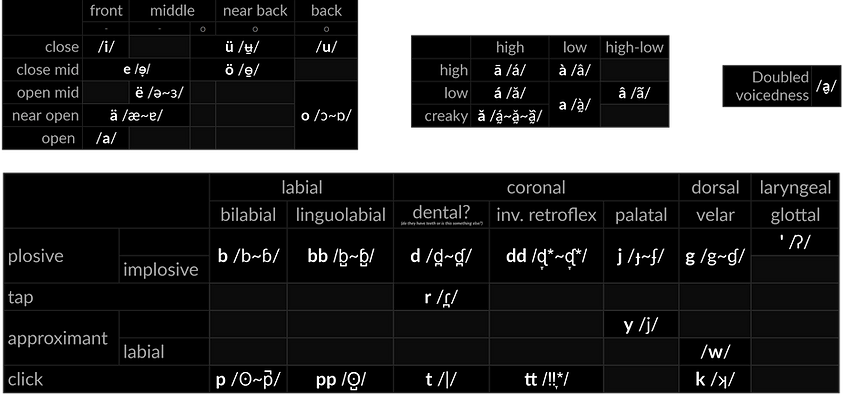
Some specifics about this phonology ;;
-
Vowels can combine with each other freely, meaning all possible diphthongs and triphthongs are technically valid. Many of these combinations are only theoretical, though, and not actually found in daily speech. There are some general tendencies to keep in mind ;;
-
Vowel glides beginning with I or U are analyzed instead as beginning with Y or W. Starting O might also be analyzed as a W.
-
Most of the time, vowels with a diaresis will be at the beginning of the glide.
-
So this means ëeu, öo, and üa are much more common than eëu, oö, and aü.
-
In fact, while technically possible, there are no documented diphthongs ending in final ä.
-
-
Normal vowels, creaky voice vowels, and extra voiced vowels do not combine with each other.
-
When these occur in hiatus (such as in the given name Pë̌-ē̬) a hyphen is used to distinguish the two syllables.
-
-
For ease of transcription, voicedness and tone is only marked on the first vowel in a diphthong or triphthong.
-
-
All consonants are valid at the beginning of syllables.
-
Y and W can combine with all other consonants except each other to create initial clusters like RY, GW, JY, and 'W.
-
P is the only consonant that can end syllables, and only occurs at the end of words. This pronunciation is far closer to a normal plosive, and usually unreleased as p̚.
-
If a syllable includes a creaky voiced vowel, any voiced consonants often become creaky voiced as well, though not phonemically.
-
Tones in Bābbé̬p are traditionally numbered in a specific order ; 1 is high, 2 is low creaky, 3 is rising, 4 is falling, 5 is high creaky, and 6 is falling-rising.
-
Tone 5 has a fair amount of variation, though nowadays is considered a high creaky tone. Historically it was a falling-rising tone, which explains its allophonic variety, placement in the tone order, and spelling.
-
-
That inverted retroflex series is another unique feature of Bàbá̬yǟ̬ anatomy, and is effectively the same as a normal retroflex but with the tongue curling downwards instead of upwards. Historically, the language used to have a phonemic "normal" retroflex as well as the inverted one, which has since been lost to sound changes.
RA5__BA1__WI5_
I N T E L L I G E N C E
One of the most characteristic features of Bābbé̬p grammar is its focus on the perceived intelligence of nouns, functioning very similarly to an animacy hierarchy. All nouns fall into one of six classes ;;

All adjectives and articles are inflected to agree with the intelligence level of the noun it modifies. Verbs can also be adjectivized in this way to create certain phrases! Each word is classified using a vowel, its voicing, and its tone patterns. A combination of these three defines which declension pattern to use! Below is a list of declensions and their endings. There are two lists on here, but nearly all words fall under the first set. We'll tackle the second set in another section of the site!

It's important to keep in mind that these declensions are nearly always regular with very little variation!*
*The variation that does pop up can be seen when inflected forms end in w- or y-, where depending on the declension, they might turn to 'w- and jy-, respectively.
we might turn to u, and yo might turn to ü!
Gō̬ (“different”) is an O̬1 adjective, meaning it is an O class, hypervoiced adjective of type 1. To inflect it into the Smart intelligence, it’s put in its inflected form G-, given the proper suffix and tone according to this chart, ending up as Gwā̬.
GO4UX_koo4ux_
GWA1_R2YA1_
GPO4UX_R2KUU4UX_
GPU1_rpe5_
GU4_tte4_
GO1_BBO5_
Gò̬u kö̀u
Different geniuses
Gwā̬ ryá̬
Different people
Gò̬up rü̬̂up
Different children
Gū̬p rěp
Different books
Gù̬ ttè
Different rocks
Gō̬ bbǒ̬
Different beds
Determining the declension of an adjective without consulting a dictionary isn't impossible a lot of the time with some intuition, but it's recommended to check anyway.
There are some adjectives that, when inflected and put in front of the subject, indicate a certain grammatical mood, but none are relevant for this text.
BBPE3__jpe1_
W O R D O R D E R
Word order in Bābbé̬p is always Subject-Verb-Object. There is no grammatical construction that strictly defies this, and intransitive verbs are even given separate forms to clarify that there is no true object in the clause. That being said, though, that's not to say there aren't some complications that arise as a result of this strict system...
In every sentence, the subject must be equal or higher intelligence than the object, even if it's the lower intelligence noun as the Agent (the doer of the action). In order to convey this agency without swapping the order, a special inverse marker Bbī is placed before the verb. This marker can also be placed in front of both the subject and the object for more subtle differences in meaning!
YA1_bbi1_te_JPE1_:
_YA1_te_JPE1_:
bbi1_YA1_te_JPE1_:
YA1_te_bbi1_JPE1_:
Yā̬ te bbī jē̬p.
It is it that hears me.
Yā̬ bbī te jē̬p.
It hears me.
Yā̬ te jē̬p.
I hear it.
Bbī yā̬ te jē̬p.
I am heard by it.
Non-transitive verbs are either intransitive by default, or possess a special detransitivized form that is used when there's no object in the clause. There are many verbs with completely separate transitive and intransitive forms, but for many, their intransitive versions
are made by taking the inflected form of their transitive counterpart and adding a suffix like -e̬up, -ëup, -ùp, or other similar variations depending on the word. Though there are two forms most of the time, knowing which one to use is very simple ; Use the transitive verb if there's an object following it, and the intransitive if there's not.
_YA11_tke_:
YA1_te_JPE1_:
Yā̬ teup.
I hear.
Yā̬ te jē̬p.
I hear it.
BBPE3__jpe1_
A R T I C L E S
Though small, the indefinite and definite articles play an important role in this language and how it functions!
There's one indefinite article Ke (inflected form K-, E2 declension), but two definite articles Gī̬ (G-, I̬1) and Bà (B-, A3). Gī̬ is the article used for definite singular nouns, and Bà is used for definite plural nouns. Note that the definite article is the only place where plurality is marked! Outside of the third person pronouns (which have separate plural forms), all nouns are ambiguous to number and only show plurality through the definite Bà.
kpe3_rpe5_
Kép rěp
A book
GYPXE1_rpe5_
Gyē̬p rěp
The book
bpxee4_rpe5_
Bë̀p rěp
The books
The above, however, are only the forms of the articles that appear when they're at the beginning of a sentence. Each article has a separate version that is used when they're in the middle of a sentence! Ke turns to Ge, Gī̬ turns to Ī̬, and Bà turns to Bâ. These initially came about as a result of lenition, thanks to how common they are.
PE4_gpe3_rpe51_
pe4_YPE1_rpe51_
PE4_b2pxee4_rpe51_
Pè̬ gép rěp
On a book
Pè̬ yē̬p rěp
On the book
Pè̬ bë̂p rěp
On the books
Bābbé̬p grammar is functionally zero-copula ; that is, there's no word for "to Be"! ...at least, for the most part. Most copular sentences use an article in between the subject and object, and given Bābbé̬p's concrete word order restrictions, articles are traditionally treated as standing in as a verb in those instances. This is further compounded by the fact that a different verb, Jē, is used for copula-like sentences that use an adjective as the object.
JPE1_gpe3_rpe5_.
JPE1_je1_rpe5_.
Jē̬p gép rěp.
It is a book.
Jē̬p jē gō̬.
It is different.
There is no locative copula, and as such, those sentences are the only ones in Bābbé̬p where there is truly no copula at all.
ke__ddypxe1__je4__BBE_
S P E C I A L A D J E C T I V E S
The second list on the adjective endings is noticeably missing the bottom half of the intelligence tiers. These are known as the "Special" or "Old" adjectives, and are remnants of the previous intelligence marking system before the current 6-tiered version took over. As this is a fossilized system, only very particular, common adjectives take this paradigm (notated as a2 in the dictionary) and are almost always words that would be considered prepositions in English.
Thankfully, these adjectives work very similarly to the normal ones, simply following different declension endings. That being said, these are common words and therefore unfortunately not without their exceptions.
Other than their different endings, the biggest defining characteristic about these special adjectives is how they treat the other half of the intelligence tiers. Tier 1 and tier 4 use the same endings, tier 2 with tier 5, and tier 3 with tier 6. But that's not to say that these pairs are marked identically ; Tiers 1-3 go directly before the noun it modifies, while tiers 4-6 go before any other adjectives.
koou_weeex_koo4ux_
KEE3_wtta_R2YA1_
KOOU_wpaa3ox_R2KUU4UX_
weeex_gpe3_rpe5_
wtta_ge_tte4_
wpaa3ox_GE5_BBO5_
Köu wëe kö̀u
With a genius
Kë̬́ waep ryá̬
With a person
Kö̬u wä́op rü̬̂up
With a child
Wëe gép rěp
With a book
Waep ge ttè
With a rock
Wä́op gě̬ bbǒ̬
With a bed
S W I T C H R E F E R E N C E
bo__DDPEE1__'YPXE3_
Along with the intelligence hierarchy, Bābbé̬p's switch reference system is another vital part of its grammar structure. These words function as conjunctions between clauses, but also indicate whether the subject in the following clause is the same or different than the previous clause. If different, it also indicates the relative intelligence level of the new subject in relation to the first.
Thanks to all this baked-in information, if the next subject is understood from context, there's no need to specify it after the conjunction! Thus, these words turn into what are effectively pronouns, and can take adjectives like any other subject would.

Yā ddyèup wà teup.
I see and I hear.
Yā ddyèup dā teup.
I see and you/they/it hear(s).
YA1_ddykxe4_wa4_tke_:
YA1_ddykxe4_da1_tke_:
These switch reference words are used in a lot of grammatical constructions! Here's some examples which may be relevant ;;
-
The relativizing markers Bà̬, Kò, and Kwǐp are also used for Infinitives. Thanks to these acting as subjects, the initial verb preceding them is detransitivized if it isnt already intransitive.
-
"Yā̬ gùp kò bbo̬." / "I want you to rest."
-
-
To show Possessives, the relativizing markers are placed after the possessed noun and followed by either Ddō, or less commonly Kó̬p (which is optional, and only used for inalienable possession by intelligence tiers 1-3)
-
In the example Ttè kò ddō (“my rock”) it can be seen that there isn’t any possessor specified due to switch reference markers filling in for pronouns, and therefore, context is often the only determining factor on who the possessor is. They can be optionally added for clarity, so for this instance, it could be Ttè kò yā̬ ddō.
-
It is common to see possessed nouns not take any articles, even if they are singular.
-
While pretentious old folk insist that an additional relativizing marker must come after Ddō/Kó̬p in order to return us into the main clause, most speakers now ignore this as an unnecessary extra step, and thus it is implied.
-
DDPE1__BBPE3_
T E N S E S
For Bābbé̬p speakers, time is interpreted as getting faster the further into the future you go. This is a pervasive aspect of how many tense-related words are formed!
Tense is expressed entirely analytically, either with markers before the verb or adjectives before the subject, and occasionally both. The most simple way to express tense is by not marking the verb at all! This gives a present tense meaning. Past tense is simply marked by putting Ǖ ("slow") before the verb, and simple future takes the adjective Yi ("fast, later", Y-, I2) and inflects it based on the intelligence of the subject. The optional marker Ja̬ can replace Ǖ for a far past meaning, but this isn't too common nowadays.
YA1_0uu1_ddykxe4_
_YA1_ddykxe4_
JYA3_YA1_ddykxe4_
Yā̬ ǖ ddyèup
I saw
Yā̬ ddyèup
I see
Jyá̬ yā̬ ddyèup
I will see
In addition to these, there are many specific words used for relative tenses ;;

Thanks to the recent advent of time travel, relative tenses can also be extended to alternate timelines. These alternate timeline tense markers repurpose switch reference markers, specifically those of different subject of equal or higher intelligence.
The logic supposedly used here is that instead of referring to a different (but equal) subject, they're effectively modifying the verb to be done in a different but equal space!
Note that these are purely modifying the verb, and in a normal sentence they go right next to any relevant switch reference markers that are doing their job as normal. Speakers just have to know which one is used for which purpose! This is generally not an issue for the Bàbá̬yǟ̬, but it might be difficult for learners to parse.
Though not standardized yet, we're seeing younger speakers increasingly using these "theoretical alternate timeline" markers as their primary way to convey a Conditional mood!
Keep in mind that if there’s a repeat tense marker in a sentence, the second one is often omitted.
ddi1__bbpee3__BBPE3_
V O C A B U L A R Y
Listed are all the vocabulary words needed to translate this webpage, including most of the examples, and of course the relay text! Note that this list presents the dictionary forms in alphabetical order according to the Gyē̬p tobbě̬ pē̬p writing system. As this writing is vertical, the native Bābbé̬p text is rotated to lay on its side for our purposes here. (the script won't matter for this relay, though.) (also if you're on mobile, that part doesn't even show up lol)
Bābbé̬p makes use of analytically compounded words for certain meanings ; As requested, the meaning of any compounds are not explicitly listed in this dictionary. And unless specified, the inflected form of a word is its first consonant.
If there’s any words you see that aren’t directly stated in the dictionary, please make sure you read through the grammar to look for any inflections and other information that might assist in identifying a word’s meaning! I tried my best to make sure all the information required is available, but not too easy. (minus the compounds specifically requested to be left out of course!!)