

TlddddiLhduoRhddoH3TlddddiLhduoRhddoH3 TlhLhuRhduoH1
T Ë M Ó G A G A
T H E N A R R A T I V E D A N C E S O F 1 5 D
o >e g o k OlLdduH2 TlddddiLhduoRhddoH3 TlhLhuRhduoH1
L E A R N T H E L A N G U A G E
The local bands of Wëza̤m are known as the H1 Tézilei people, who each speak different varieties of what we're coining to be the TlddddiLhduoRhddoH3 Móga family ; A collection of closely related languages that emphasize storytelling and movement.
Móga comes from a local word that just means "language"!
We currently have permission to facilitate tours shadowing four bands along their regular semi-nomadic cycle of the continent. Their languages are TlhLddduoRddddiH2 Wëzo̤le̤, OTrhduoLhddoRhduoH3 Eza (known locally as OluiTrhduoLhddoRhduoH4 Haro), LhduiH0 Timao (k.l.a. LhduiHt Vestikom) and OTlhLhRduH2 Kezgeza (k.l.a. OTlddLddRhH# Kaʂkaʂo).
The primary contact we have with 15D has been through the Wëzo̤le̤-speaking band, so for this documentation we'll be using the local Wëzo̤le̤ names for each of these four languages.
TlhLddduoRddddiH2
OluiTrhduoLhddoRhduoH4
LhduiHt
OTlddLddRhH#
If you haven't seen this video, we highly recommend you watch it before going further to familiarize yourself with the Móga languages and Tézilei culture!
Móga languages are best known for their use of signed components spoken in tandem with oral speech, an evidentiality system baked into their absolutive case, and verbal suffixes which detail the direction and speed of the action being performed.
They are primarily Subject-Object-Verb, but in day-to-day speech it's also common to hear the subject moved to the end of the clause if the speaker wishes to emphasize the object. This is with the exception of Wëzo̤le̤, however, which has fully shifted to Object-Verb-Subject for all sentences. And, despite having no verb agreement, Móga languages allow optional omission of subject pronouns if meaning is clear from context.
Adjectives are put before the nouns they modify, and non-core constituents (plus conjunctions like "because" or "but", though not "and") are usually put between the object and the verb.
Móga languages are relatively agglutinative, and though learners will have to remember how certain morphemes combine, the patterns are usually regular with few exceptions.
C H A P T E R S
Click a section to skip to it.
LhduiHo TrduLduH2 Ho
P H O N O L O G Y
Though the specifics of each phonology differ for every language, all documented Móga languages exhibit a number of shared traits ;;
-
A rather small phonological inventory in the spoken word, most making use of only 5-7 phonemic consonants.
-
As such, the exact pronunciation of each phoneme is allowed to be quite varied depending on the speaker and the situation, given there are also plenty of other ways to determine what the speaker is saying.
-
-
A regular stress pattern, which is usually phonemic. Unless otherwise specified with an acute accent in the romanization (á), default stress goes the second syllable in disyllabic words, and the penultimate syllable in words of higher syllable count.
-
All documented Móga languages which have long vowels allow them to be in unstressed positions.
-
In rare cases, there may be two syllables with an acute accent (TlduLhduiH1 Wéléoo, for example), which means both syllables get stressed equally. Some idiolects likely choose one or the other.
-
Stress is also intertwined with vowel hiatus, which is allowed. If vowels are in hiatus, this will always be indicated by an acute accent, and/or one being a long vowel.
-
In syllables that break the default stress pattern, it is also common to hear the following consonant (if there is one) become geminated for some speakers. This is purely allophonic!
-
-
Some kind of phonemic breathiness, be it via a breathy-voiced vowel, devoiced vowel, and/or a preceding aspirated consonant.
-
An extensive inventory of possible poses, which are signed simultaneously while orally speaking the morpheme that the sign is assigned to. Though spoken word inflects for case, plurality, etc., signs don't inflect for anything, per se, besides verbal motion+speed information.
-
This means that simply watching a signer without hearing them doesn't guarantee the full meaning of the sentence is conveyed... That being said, however, context and word order will likely do a lot of work to help speakers grasp the general meaning of the sentence just by visual cues alone.
-
These poses disambiguate orally spoken homonyms, but there are some poses that are identical or very easy to mix up when watching someone speak quickly. Usually when words sound the same, they look different, and when they look the same, they sound different.
-
All this means that the oral language is inseparable from its signed components, and vice versa. Keep a close eye out for important distinctions between everyday words like the interjection LddRdd Mat ("yes") and the verb OrTrhduiHo Mat ("it isn't"), along with other verbs like OTrdd Mat ("turn around")! This is why, in some of our example words, we've put the written sign next to the word's pronunciation.
-
-
Note the use of the word pose ; Móga's signed components are always defined by a specific, static combination of limb positions and hand shapes, making the signed space very large. Some words then additionally include a movement to further specify meaning, which is usually performed by one or two hands (though sometimes the tail is moved instead), and/or a movement of the body to convey relative spatial information.
-
This means that, unlike many signed languages, a static pose is frequently enough to convey a concrete meaning, hence the use of the word "pose" in this documentation.
-
-
This signed inventory in tandem with orally spoken word would likely best define Móga languages under the realm of the Village Sign category, especially since most speakers have unimpaired hearing, and a large amount of grammatical information is only conveyed audibly. It is definitely not comparable to communicating in english and ASL at the same time, for example!
-
Also, note that our notation here chooses "right" and "left" as the listener's right and left, not the speaker's. Though many Móga signs entirely change their meaning when flipped in isolation, if a whole sentence's signs are mirrored, it is generally still able to be understood. After all, it's useful to be able to understand someone even when their back is turned!
-
As such, which direction is "right" and which is "left" is mostly context-dependent ; it's a little closer in meaning to "this side" and "the other side" rather than concrete rights and lefts.
-
-

Wëzo̤le̤'s standard spoken phonology is relatively typical for a Móga language, though there are some characteristics that stick out compared to its siblings, such as its sizeable array of diphthongs and its two long vowels (which, uncoincidentally, fill in the two gaps in the diphthong table). It also has three voiced allophones which arise in the middles of words.
Some example words include ;;
Ka̤lii ("squirrel-like animal") TrhuLddhiRddhiH1
Izmaló ("mustn't") OTrhLhuH0
Elgemeok ("temples") TrduLhdRhddoH3TrduLhdRhddoH3
Mé̤ëo ("raise") OTrhduoLduRduH3
Along with the other phonological rules all Móga languages follow, Wëzo̤le̤'s standard oral phonology follows these additional rules ;;
-
Breathiness can be applied to any vowel and diphthong. Only the first vowel of a diphthong is given the diaresis below in the romanization.
-
It's standard to have this breathiness be realized as breathy voice, but using devoiced vowels isn't uncommon in certain circumstances. Generally, devoiced vowels are more often heard coming from children, particularly following the voiceless consonants T, K, and S. Sometimes parents will mirror this voice pattern back to their children when speaking to them.
-
Children are also known for very regularly fronting ɑ to a, though adult idiolects occasionally front it as well in free variation.
-
-
-
If a word has a diphthong (including II and OO), it's nearly always the final syllable.
-
Since Wëzo̤le̤ has a phonemic schwa and follows all the expected Móga stress patterns, schwa can be stressed.
-
It is not unheard of, however, to hear a stressed schwa changed to E for some speakers. This likely comes from its pronunciation prior to the Wëzo̤le̤ chain shift.
-
-
A word beginning with a vowel may optionally have a glottal stop inserted before it to separate it from other words.
-
This is more commonly heard on words that put the stress on that initial vowel, like TrhduoLhduoRhduoH3 Éloo ("important")
-
-
W can only be at the beginning of words, minus an exception or two for loans.
-
G is an allophone of K, Z is an allophone of S, and L is an allophone of T. These only appear in the middles of words.
-
L is usually a lateral fricative, but can also be pronounced as a tap, or a voiced plosive. Using the voiced plosive for this consonant is generally perceived as making the speaker sound older and wiser.
-
-
T, K, M, and S are valid codas at the end of words. In the middle of words, most of their voiced allophones (including M, which stays the same) can combine freely with each other in clusters of two.
-
The legal intervocalic clusters are LG, LM, LZ, ML, MG, MZ, ZL, ZG, and ZM. Note that the only illegal combinations are the ones starting with G.
-


Every pose in Wëzo̤le̤ uses a combination of limb positions pictured here. In addition, some also include movements, listed below the main table.
Some notes ;;
-
Some combinations of these limb positions are not phonemic in Wëzo̤le̤. For example, combining a diagonal up upper arm with a horizontal out forearm, which does not show up in any words, or a diagonal down upper arm with a down forearm.
-
To be clear, these combinations are only unused when they're both on the same limb.
-
-
Hand shapes are usually on both hands, unless one hand is holding something.
-
For this band in particular, is common for the Tézilei's left arm (right, to the listener) to be holding a long spear, which may hinder movement slightly. Tézilei certainly are not afraid to swing it around, but generally speaking, that arm might have more limited movement for many speakers, even when a spear is not held.
-
The final two leg positions are allophones of the open legs position, which come about when the open legs combines with raised limbs (i.e., not "down") that are only on one side of the body.
-
With only two truly phonemic leg positions, Wëzo̤le̤'s pose inventory is the smallest.
-
-
Movement directions can be combined ; for example, backward and away from the body.

Eza features vowel length in place of the Móga stress system, aspirated consonants in place of the normal breathy consonants, and nasal vowels.
Some example words include ;;
Rõõf ("sunset") SluiTrhduoLduRduH3
Paake ("hesitate") RuiTlduhiLduhiH2
Rhẽpuh ("write") OruiTlduH4
Tö̃kir ("high") RuiRh
Along with the other phonological rules all Móga languages follow, Eza's standard oral phonology follows these additional rules ;;
- All vowels can be nasalized, and all vowels can be lengthened. These two qualities can be combined.
- Stress is completely regular ; any stressed syllables in other Móga languages outside the default pattern have been changed to increased vowel length. That being said, stress in general in Eza is a lot looser due to the vowel length covering for the old stress system ; it's not uncommon in Eza speech and music to hear a syllable deliberately stressed outside the regular pattern. In these instances, the syllable that should have been stressed is generally lengthened to compensate.
- Breathy vowels have been replaced with aspirated consonants. This is a very subtle difference in pronunciation, likely indistinguishable in some circumstances, but this is how Eza speakers interpret the sound phonemically! This difference in interpretation is evident in their spelling, where they would prefer to write uht (t + h + u) instead of uHt (t + ṳ). Most other Móga languages find Eza's way of spelling to be a strange and unnecessary waste of space.
-
All consonants, besides aspirated consonants and W (so P, T, K, R, F, S, and H), are valid codas at the ends of words.
-
The allophones F and S can only be codas, and S is also the only coda that can be in the middle of words.
-
As such, these are the only two consonants that never get aspirated. (besides H, which is already aspirated anyway)
-
-
Though infrequent, some codas can be consonant clusters. These clusters are SP, ST, SK, and TS.
-
-
R can combine with plosives to create initial clusters PR, TR, and KR. Aspirated versions PRH, TRH, and KRH are also allowed.
-
Combining the aspirated plosives with the aspirated R isn't phonemic, though it's likely that some speakers pronounce PRH, TRH, and KRH with aspiration on both consonants in the cluster. (so something like KHRH)
-


Every pose in Eza uses a combination of limb positions pictured here. In addition, some also include movements, listed below the main table.
Some notes ;;
-
Compared to other Móga languages, Eza is the least likely to mirror the hand shape on both hands, only using the dominant hand of the pose (which is usually left)
-
Out of all the Móga languages we've seen, Eza has easily the most leg positions.
-
The second and third columns are allophones, however, being versions of the position in the first column, which show up to effectively "counteract" an imbalance on the body. So for example, if both arms are in use, and the tail is on the left, the leg on the right will bend.
-
Columns 5 and 6 are "leaned" and "leaned further" respectively, the latter usually involving a more deliberate movement of the torso. These two are generally rather rare.
-
Despite how many variations there are, Eza speakers sometimes completely drop them in casual conversation. They're primarily used for music in ceremonial retellings, though do also show up when the speaker is excited.
-
-
Eza notably lacks any up or down in their post-pose movements. They certainly can move their arms up and down, but doing so doesn't carry any necessary phonemic information.
-
Movement directions can be combined ; for example, forward and toward the body.
-

Timao's most notable phonetic feature is perhaps its diphthongs, which appear (mostly) allophonically on stressed syllables. It is unique among the Móga languages to have V in place of W.
Some example words include ;;
Vekim ("change") LuiTrduLddRduHm
Ci'keis ("wind") Rh
Şéia' ("short") TrduLddRduHv
Sa̤me̤u ("other") OTlduRhHm
Along with the other phonological rules all Móga languages follow, Timao's standard oral phonology follows these additional rules ;;
- Breathiness can be applied to any vowel and diphthong. Only the first vowel of a diphthong is given the diaresis below in the romanization.
- Timao has the concept of what they call "heavy" and "light" vowels, where every vowel and diphthong is paired with another. Stressed syllables take the heavy versions, and all other syllables take the light versions. In monosyllabic words, normal vowels are usually light and breathy vowels are usually heavy.
- Light I is paired with heavy EI.
- Light U is paired with heavy OI.
- Light O is paired with heavy OU.
- Light E is paired with heavy I.
- Note this is the only heavy vowel that isn't a diphthong!
- Light A is paired with heavy EU.
- Because of this, nearly all words with abnormal stress no longer need to be marked with an acute accent.
- There are a few words that break this pattern, however, like H1 Móvas ("seven"), which doesn't follow the normal light/heavy contrast. As such, the acute accent is still required for those exceptions.
- Before the pairs I/EI and U/OI, Timao goes through a regular process of changing T to C, and S to Ş.
- C and Ş are primarily just allophones, but they're marginally phonemic due to a small amount of minimal pairs between them and the consonants they changed from, such as Soi ("speak", infinitive) and Şoi ("feather")
- All consonants besides T, V, and H may be codas.
- Where there used to be a final T, the glottal stop ' replaces it. As such, this consonant can only be a coda.
- The default nasal is M, but as a coda it assimilates allophonically to N and NG depending on the place of articulation of a following consonant. This is even present between words for some prepositions.
- H is only found at the beginning of words.
- There are 9 consonant clusters that can appear within the middle of words, being 'K, 'V, 'S, NT, NGK, NS, ST, SK, and SV.
- Of these clusters, NT, NGK, NS, ST, and SK may appear word-finally in rare occasions.


Every pose in Timao uses a combination of limb positions pictured here. In addition, some also include movements, listed below the main table.
Some notes ;;
-
Some combinations of these limb positions are not phonemic in Timao. For example, combining a diagonal up upper arm with an up forearm, which does not show up in any words, or a diagonal down upper arm with a horizontal out forearm.
-
To be clear, these combinations are only unused when they're both on the same limb.
-
-
Timao has the most Móga hand shapes documented, with 15.
-
If both arms are in use, some speakers completely forego leg position 1 and use position 2 instead. This is sometimes dropped when speaking casually.
-
Positions 3 and 4 of the legs are allophones of position 2, which show up to effectively "counteract" an imbalance on the body. So for example, if both arms are in use, and the tail is on the left, the leg on the right will bend.
-
Position 5 of the legs is "squatted", and is not very common.
-
Positions 6 and 7 of the legs are "leaned" and "leaned further" respectively, the latter usually involving a more deliberate movement of the torso. Like the squatted legs, these two are generally rather rare.
-
Movement directions can be combined ; for example, up and forward.

Oral Kezgeza immediately stands out from the crowd with its 10 vowels, frequent consonant clusters, and gemination, the latter of which is completely unique within Móga.
Some example words include ;;
Mátoʂ ("smart") OrTlddLddduoRddH0
Tünte̤ʂa ("unexpected") OS
Oʂtomën ("fly") OLddRdd
Şttu ("must") OTrdd
Along with the other phonological rules all Móga languages follow, Kezgeza's standard oral phonology follows these additional rules ;;
-
Breathiness can be applied to any vowel.
- Words follow front-back vowel harmony based on the stressed syllable.
- The front vowels are I and E, and the back vowels are U and O.
- I is entirely dropped when unstressed, so it doesn't have a backed version. The backed version of E is Ë.
- The fronted version of U is Ü, and the fronted version of O is Ö.
- A is considered neither front nor back, so when unstressed it takes on whichever position the word is, being either Ä for front words or Ɐ for backed words.
- Because A is neutral by default, when it's a stressed syllable, it causes no backing or fronting of other vowels in the word. In the event there is a front vowel and a back vowel in the same word, and A is the stressed syllable, unstressed syllables are generally harmonized according to which syllable is closest to (or part of) the stressed syllable of the root word.
- This harmony is not always fully followed for certain words ; it's not uncommon to see the backed Ɐ or Ë beginning words that are otherwise neutral or fronted, or a neutral A beginning all indefinite nouns regardless of the harmony in the rest of the word.
- Despite having 10 vowels and harmony in affect, Kezgeza's vowels are still quite variable in terms of the actual quality they take. It's not uncommon to hear unstressed vowels reduced to schwa, and stressed vowels can really exist anywhere in their horizontal vowel space as long as contrasting vowels in the same space are also moved to compensate.
- All this works because signed components assist greatly in disambiguating what vowels are actually being intended, and as such, they have extra flexibility.
- The front vowels are I and E, and the back vowels are U and O.
- M is N in coda position, and M everywhere else. M cannot be found next to a breathy vowel.
- N is best described as an allophone, but there are certain phonetic conditions that allow M as a coda which contrasts with N, crucially between negated and non-negated forms of some verbs. As such, N can be considered marginally phonemic.
- Whenever M may be placed adjacent to a breathy vowel, it will turn to F.
- T, K, and F, along with rarely M, Ş, and C, can geminate to TT, KK, FF, MM, ŞŞ, and CC, which can be found at the beginnings, middles, and ends of words.
- Most consonants can combine with each other in clusters, which can be found anywhere in a word. It's not incredibly rare to see three consonants in a row, such as in OTlddLddddiRddddiH# Kʂmat ("continue") and OrTrddH1 Äʂfʂec ("abandoned"), or using geminates like the word OrTlddduoLddduoRddduo Tkkon ("throw").
- In the final example, some speakers will pronounce the T as an ejective.
- C is a marginal phoneme, as it's primarily just analyzed as a combination of T and Ş, which is reflected in their spelling as well.


Every pose in Kezgeza uses a combination of limb positions pictured here. In addition, some also include movements, listed below the main table.
Some notes ;;
-
Kezgeza's poses have relaxed to a point that there is no phonemic diagonal up on their upper limbs.
-
There are no poses that use only one arm. Poses either use no arms, or both.
-
As such, hand shapes are always on both hands.
-
Movements are also likely to be done using both hands as well, but only if the arms are perfectly symmetrical in the initial starting pose.
-
-
Positions 3 and 4 of the legs are allophones of position 2, which show up to effectively "counteract" an imbalance on the body. So for example, if both arms are in use, and the tail is on the left, the leg on the right will bend.
-
Position 5 of the legs is "squatted", and is not very common.
-
Positions 6 and 7 of the legs are "leaned" and "leaned further" respectively, the latter usually involving a more deliberate movement of the torso. Like the squatted legs, these two are generally rather rare.
-
Movement directions can be combined ; for example, down and backward.
LdduRddHk LdduRddHk TlduLduRddhoHk
C A S E + E V I D E N T I A L I T Y
All Móga languages employ some kind of case system, usually via prefixes, and what is best described as some kind of ergative-absolutive alignment, which is why the term "absolutive" is used in this documentation instead of "accusative". In short, Móga languages treat most nouns without direct agency as the patient in the clause, even if they're the subject of the sentence. In reality, though, there are some scenarios in which this isn't the case ; Móga languages disallow more than one absolutive case to coexist in a clause, and therefore if a sentence has an object, the subject must be in the ergative (and therefore unmarked) as a result, even if that subject does not have agency. An example sentence of this type would be Të ozomoi mazei se̤ ("I am caused to push the box", in Wëzo̤le̤) ; despite the subject not having agency, as they're being made to do something, "the box" is already the object and therefore the subject must be unmarked. To truly specify the subject's lack of agency in these kinds of unclear situations, the word O Ëma̤ / O Hẽf / O Hemo̤u / O Ëfo̤ can be put directly before the verb, which effectively "passivizes" the sentence.
Due to their propensity for storytelling, there are usually around five absolutive case markers, each conveying different evidential meanings to the sentence. For our initial examples here, we'll use the Wëzo̤le̤ noun TlhuLhdRhddoHc Omoi, meaning "box". Note that if the general knowledge marker is used, it is often not fully spelled out in writing, since omitting the spelling often implies that a patient has the general knowledge marker (especially in Wëzo̤le̤, thanks to its word order).
.O&TlhuLhdRhddoHc
Melomoi ëo.
It is a box.
(from general knowledge)
.Oiomoak&TlhuLhdRhddoHc
Káomoi ëo.
I see that it is a box.
(they see it and know what boxes look like)
.Oiomomit&TlhuLhdRhddoHc
Timomoi ëo.
I hear that it is a box.
(perhaps it made a hollow sound when hit)
.OiomozoTlhuLhdRhddoHc
Ozomoi ëo.
It feels like a box.
(this is in regards to physical touch)
.Oiomom>ewTlhuLhdRhddoHc
Wëmomoi ëo.
I've heard that it's a box.
(they have no firsthand evidence)
All documented Móga languages also have three more cases, used for non-core constituents: the Genitive, Locative, and Comitative. Note that unlike english and many other languages, their comitiative does not overlap with the instrumental.
,,iomozik&TlhuLhdRhddoHc
Kizomoi...
A box's...
(genitive)
iomolew&TlhuLhdRhddoHc
Welomoi
In a box / At a box
(locative)
iomomotTlhuLhdRhddoHc
Tomomoi
With a box
(comitative)
In nearly all sentences, locative and comitative constituents go directly before the verb. It isn't considered incorrect to put them in other parts of the sentence, but it would instead feel somewhat old-fashioned and is treated as emphasizing that particular part of the sentence.
Adverbs are created by putting the adjective in the locative case. Since this locative is nearly always directly before the verb, there's no ambiguity surrounding the adjective being potentially part of a larger noun phrase!
Besides Wëzo̤le̤, which also has a vocative case, and Timao's expanded epistemic markers, these are all the case prefixes present in the Móga languages we've seen. While they are quite regular, most do attach agglutinatively with some minor phonological changes depending on what word they attach to ;;
Wëzo̤le̤'s system is largely predictable, with the only primary variations being that some cases bring about metathesis in monosyllabic words, and that the root's beginning consonant will voice. All nouns follow this regular system, even pronouns, with only a single exception: the third person visual absolutive is Trdu Kë́o̤, not the expected Káo.
Wëzo̤le̤'s case prefixes are Mel- (absolutive gen.), Ka- (absolutive vis.), Tim- (absolutive aud.), Oz- (absolutive tact.), Wëm- (absolutive hears.), Kiz- (genitive), Wel- (locative), Tom- (comitative), and Wëz- (vocative). If this chart is difficult to read in your browser, you can download the full quality image here!

Eza's default case prefixes are Pat- (absolutive gen.), Ko- (absolutive vis.), Tĩp- (absolutive aud.), Hur- (absolutive tact.), Wẽp- (absolutive hears.), Kir- (genitive), Wat- (locative), and Tũp- (comitative), which also attach agglutinatively.
As with Wëzo̤le̤, the third person visual absolutive is an exception ; it's Kee, not the expected Koou. If this chart is difficult to read in your browser, you can download the full quality image here!

Timao's case system is considerably different than the others, where (barring certain words, which will be discussed later) case prefixes have been largely detached and act as prepositions. That means there's no need for a complicated flow chart!
They haven't fully detached however, since they're often pronounced slightly different when they come before certain consonants.
Ma'
Meu (t/c)
Abs. General
Ko
Ki (v)
Abs. Visual
Cei
Cin (t/c/s)
Cing (k)
Abs. Auditory
Hus
Hoi (s)
Abs. Tactile
Vei
Ven (t/c/s)
Veng (k)
Abs. Hearsay
Kis
Kei (s)
Genitive
Va'
Veu (t/c)
Locative
Coi
Cun (t/c/s)
Cung (k)
Comitative
Timao has also innovated several more prepositions to extend this evidentiality system in the form of what might be best described as epistemic markers. These seem to have their origins in referencing the Móga pantheon. As these are new inventions, they don't change pronunciation based on whatever word is after them. They can go before basically any part of the sentence to emphasize what part in particular the speaker is sure or unsure about, though the default is to put it on the patient (if there is one) just like the absolutive evidentials. They can even go before those evidentials for further nuance!
Tom vu to
I deduce or assume they're moving
Ka' vu to
It's not clear to me whether they're moving or not
Ko̤ vu to
I doubt they're moving
(can be used in positive or negative sentences ; using in negative sentences strengthens the doubt)
Ha̤k vu to
I forgot if they're moving or not
Mam vu to
I don't like it, but I must admit that they're moving
In addition to these, there's also the word OruiTlduLhduiH1 Teum, which doesn't really fit neatly into any of these categories. It acts effectively like an all-purpose intensifier, fitting definitions that might be translated in english as "at all", "even", "indeed", "totally", or others of that sort. It too seems to be able to go anywhere in the sentence to emphasize a certain aspect of it!
Kezgeza's default case prefixes are Mat- (absolutive gen.), Ko- (absolutive vis.), Tf- (absolutive aud.), Uʂ- (absolutive tact.), Ëm- (absolutive hears.), Kʂ- (genitive), Ɐt- (locative), and Tum- (comitative), which also attach agglutinatively. This flow chart is easily the most complicated, due to Kezgeza dropping certain unstressed consonants, and its vowel harmony. It unfortunately also includes needing to check cognates for some paths, as there's no truly reliable way to tell how a vowel might react in those situations without either memorizing it or checking a cognate.
As with Wëzo̤le̤ and Eza, the third person visual absolutive is an exception ; it's Ke, not the expected Kóu ; though there are more exceptions in the pronouns, which can be seen on a table below the flow chart.
If this chart is difficult to read in your browser, you can download the full quality image here!

* as you can see.. this is A LOT. it's very possible there are some mistakes in this chart, edge cases and caveats that aren't accounted for... please double check with preexisting text if you're using this!! if you see what you think might be a mistake, don't hesitate to contact us!
Some very common words may be exceptions to the above chart ;;
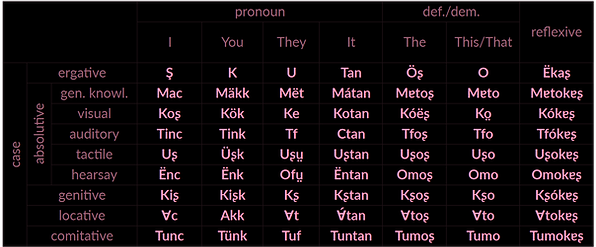
These cases are prefixes, which notably go before adjectives ; this means that they get attached to whichever word is first in the noun phrase.
TlhuLhdRhddoHc
Omoi
A box
iomolewTlhuLhdRhddoHc
Welomoi
In a box
TlhuLhdRhddoHcTlhduoLhduoHo
Sága omoi
A black box
TlhuLhdRhddoHcagazlewTlhduoLhduoHo
Welzaga omoi
In a black box
Due to this behavior, it is rather common for cases to stack (particularly with the genitive) and create words that are two different case markers and nothing else. These "null" words are called Mi̤mo̤mo / Phe phĩpu / Coim mi̤moi / Ffu, and are essential to speaking and understanding any Móga language. It should be noted that any "null" word may only contain two cases.
TlhuLhdRhddoHcilozikk
Kizoli omoi
A fox's box
TlhuLhdRhddoHcTlhduoLhduoHoilokRddddiH1
Kizgiga oli sága omoi
An orange fox's black box
TlhuLhdRhddoHcilokkiilewRh
Weliik oli omoi
In a fox's box
TlhuLhdRhddoHcTlhduoLhduoHoilokRddddiH1kiilewRh
Weliik kíga oli sága omoi
In an orange fox's black box
In the above examples, the word Weliik is conveying both that the whole noun phrase is in the locative, and that there is a subphrase within that which is in the genitive. These are used quite extensively in constructions to create a variety of meanings such as more nuanced locatives, adjective intensifiers, and more. These null words exist even in Móga languages (like Timao) which have lost the case affixation.
TrdduHkTlhuLhdRhddoHckiilewRh
Weliik omoi malë
Behind a box
(literally "in a box's back")
LhRhduiHcTlhuLhdRhddoHckiilewRh
Weliik omoi toma
Near a box
(literally "in a box's reach")
LhduoRddhoH3TlhuLhdRhddoHckiimotRh
.O&TlhuLhdRhddoHcTlhduoLhduoHoTrduLduddoRduddoH1kiilemRh
Tomiik omoi mo
From a box
(literally "with a box's story")
Meliik tamë sága omoi ëo.
It is a very black box.
(literally "it is wëzlamë's black box")


These are a lot indeed, but don't get intimidated! Nearly all of them are incredibly rare to find, and only come about as a result of certain word combinations. For the most part, only the genitive, locative, and comitative columns contain case combinations commonly used in everyday speech.
Notice how in these tables, there are words for each case on their own ; There are indeed situations where a case marker might be floating without anything attached to it! This frequently arises in sentences with relative clauses and quotative constructions, where three cases might stack up in a row. In these situations, the first case is usually left floating and the second two attach to each other, which is the only time a case prefix doesn't attach to the word directly after it.
For example, the phrase ;;
TrduaHizm>emeOTrhddoLduH1LhduoRddhoH3TlduRddHcTlhLhuRhduoH1kiimotRhRddddiHo
Wei tomiik të ko̤ mo emëmzía̤ kë̤
("in the place that you came from")
Some grammatical constructions, however, do it the other way, where the first two cases attach to each other, and the other attaches to the beginning of the noun phrase. Keep an eye out for constructions that do this instead!
Timao's prepositional system evolved directly from those floating cases, but despite the prepositions, the null words were common enough to withstand the change and thus remain a core part of the language's grammar. Pronouns, the reflexive, the definite article, and the demonstrative also still attach.
There are some adjectives and nouns that, due to their etymology, inherently possess a certain case when unmarked ; therefore, they always use the null words when given normal case prefixes. This is where the other, far less common null words come in. An excellent example is the name of all gods in Wëzo̤le̤, which inherently have a vocative case, but there are other nouns and adjectives which have this property as well, along with most native given names. As a result, these words may also give rise to the floating case marker as mentioned above!
Wëzmozoi
Wëzmozoi (a god)
(inherently vocative)
Tomai mozoi
With Wëzmozoi
Koo
Curious
(inherently visual absolutive)
Wasko ha
Curiously
Kiʂo̤im
Kiʂo̤im (a name)
(inherently genitive)
Akkit
Hips
(inherently locative)
Kiʂeis vumou...
Kiʂo̤im's...
Kʂa̤t kit
Their hips
This means that some words might take forms completely different in sound in the middle of a sentence as opposed to on their own ; compare the Timao example Kiʂo̤im vs. Vumou. This isn't a result of suppletion, it's simply sound changes at work! If a word has this property, it will be specified in the dictionary along with what case it's connected with, and the form it takes without the case attached.
TlhLhuRhduoH1
D E F I N I T E S
Like case markers, Móga's traditional definite markers attach to the first word in the noun phrase. As such, this section has been put after the case markers!
Wëzo̤le̤ is the exception and does not mark definites in the expected way, instead opting for a much simpler system. The word TlhLhuRhduoH1 Të, originally meaning something like "being in front of", is put at the beginning of the noun phrase it modifies, without ever attaching. In fact, if there is a case marker that would normally attach to the phrase, that will still attach, going after the definite marking.
Ai
A spear
Welai
On a spear
Të ai
The spear
Të welai
On the spear
Móga's traditional definite marking strategy, something present in all other documented siblings, has instead turned into Wëzo̤le̤'s vocative prefix. Remnants of its original definite meaning is still seen fossilized in a few words though, like the name of their mountain, OlLhduoH3 Wëza̤m, and in fact, the name TlhLddduoRddddiH2 Wëzo̤le̤ itself!
Eza's definite prefix Wer- works like any other case prefix, following the same attachment rules. It's useful to think of it as having the start of the Absolutive hearsay prefix (without nasalization), and the attachment rules of the Genitive prefix with its ending R. Note that this R metathesizes with any plosives!
It, as expected with the case prefixes, attaches to the ending of them.
Po
Tail
Waspo
On tail
Wepro
The tail
Wator po
On the tail
Notice how the example doesn't say "a tail", it just says "tail". This is because Eza has innovated an indefinite marker, so saying the word on its own no longer indicates indefiniteness! This prefix is Har-, and works slightly differently than other prefixes. It does indeed get prefixed onto noun phrases, acting similarly to the others (including the R metathesis), but if there is a case marker present, it gets prefixed onto that instead.
Hapro
A tail
Haraspo
On a tail
When attaching onto a word with an initial H or initial W, simply drop that initial consonant and attach Har-. If a word already starts with R, just add Ha- instead.
This prefix is cognate with other Móga words for "one"! While this is still heard for the meaning of "one", Eza's generic word for the number has been seen shifting to RduduiHk Wii.
When talking about definites and indefinites, Timao is the documented Móga language to have retained the most of the old system. Their word Ves, just like the rest of their case markers, is no longer a prefix and simply a word in itself. It does, however, still attach to the end of case markers.
Heise
A flower
Va' heise
On a flower
Ves heise
The flower
Vatous heise
On the flower
Ves used to be a prefix, and is fossilized in a few words, such as OluiTrduLduRduH3 Vísom ("the sun") and the endonym for Timao, LhduiHt Vestikom!
For Kezgeza, the definite prefix Ëʂ- is ultimately from the same source. However, because Kezgeza lacks W (which instead backs the vowel that came after it), Ëʂ- is used for fronted and neutral words, while Oʂ- is used in backed words. This means regardless of harmony, this prefix is always going to contain a back vowel and thus disobey the normal harmonic rules. And as expected, this attaches after other cases as well.
E
Wings
Tüme
With wings
Ëʂe
The wings
Tumoʂ e
With the wings
Kezgeza has directly borrowed Eza's strategy of marking indefinites, which has been rendered as a simple prefix A-. The same attachment rules as Eza's indefinite marking apply, and it is completely transparent to harmony. If the word already starts with A, then the A is stressed, again with no changes in harmony.
Aé
A wing
Atüme
With a wing
Since Kezgeza no longer marks plurals, including this indefinite prefix is a surefire way to specify you're talking about a single object ; this means the lack of plural marking is only numerically ambiguous in definite nouns.
RduH2 LdduRddHk LdduRddHk
P L U R A L S
In ancient Móga, plurality was expressed by duplicating the final syllable of the word. This is now only preserved in Wëzo̤le̤, while the other main Móga languages have evolved various other strategies.
Though the most complex of the Móga languages, Wëzo̤le̤'s plurality is far more regular in comparison to the reduplicated plurals present in the Hekenic languages. There are, however, several rules and caveats that learners will need to remember...
For pluralizing monosyllabic words, following this flow chart will always get the correct plural form ;;

Ta
Bowl
Ai
Spear
Wao
Rock
Tala
Bowls
Azai
Spears
Wama̤o
Rocks
As evident in the first example ; when duplicating a syllable, remember to turn the consonant into its voiced variant!
Pluralizing a polysyllabic word is less predictable, primarily because it's not always clear where morpheme boundaries are ; for example, is Ki̤më̤ a combination of Ki and Më̤, or perhaps Ki̤o and Ë̤? Since the final morpheme is responsible for duplicating to make the plural, for most words it's simply impossible to know without either being taught the correct plural form, or guessing based on what morphemes you think the word might be made up of. (in this case it's Ki and Më̤, so it'd be pluralized as Ki̤mëmë̤)
There are some words that unambiguously can be figured out, though! Azoot, for example, can only be a combination of Ai and Too. Thus, its final morpheme is pluralized to make Azlomoot. These unambiguous plurals aren't very common unfortunately, as they require specific phonetic environments to guarantee the identities of the two morphemes.
Eza's pluralization strategy simply puts the adjective SruiTlduLduRdu Phe in front of the noun. Note that it is treated like an adjective, and as such attaches to case prefixes and goes before any other adjectives!
ratH1SruiTlduLduRdu
Phe tar
Trees
ratH1psawSruiTlduLduRdu
Wasp tar
In trees
ratH1fuNuNtSruiTlduLduRdu
Tũũf tar
With trees
Phe takes the following forms when attached to case prefixes. These follow Eza's normal case patterns, but since Phe is rather common and some forms look rather different from the word on its own, we figured it'd be good to highlight!
-
Combined with the Absolutive (gen.), it is Pasp.
-
Combined with the Absolutive (vis.), it is Kõf.
-
Combined with the Absolutive (aud.), it is Tĩĩf.
-
Combined with the Absolutive (tact.), it is Hup.
-
Combined with the Absolutive (hears.), it is Wẽẽf.
-
Combined with the Genitive, it is Kip.
-
Combined with the Locative, it is Wasp.
-
Combined with the Comitative, it is Tũũf.
Pronouns are the only words in Eza that still take plurals reminiscent of their old forms ; Rha, Khe, Wu, and Tã pluralize to Rar, Keh, Wuh, and Tãt.
Similarly, Timao's pluralization uses a different word before the noun, that being OruiTlhLduRhduiH3 Coim. As with many grammatical words in Timao, this word only has a final M when preceding an M, V, or H. Preceding T, C, or S, this word is OruiTlhLduRhduiH3 Coin, and preceding K, it is OruiTlhLduRhduiH3 Coing. Take note that despite being a non-breathy, monosyllabic word, this word uses a heavy vowel instead of the expected light vowel! This is because Coim is a shortening of the adjective Mecoim ("bountiful").
Thanks to Timao's simplification of the case system, Coim is incredibly simple ; just put it after the case prepositions and before the noun. It's also common to duplicate this however frequently the speaker wants in order to emphasize a large amount of something. In many circumstances, they might also reduce the weight of the duplicate's vowel, making it homophonous with some forms of the comitative preposition OLhRdduH2 Coi. Signed components therefore are the only thing that separates the two words!
OluiTrduLduRddhiH1OruiTlhLduRhduiH3
Coing kenti'
Ropes
OluiTrduLduRddhiH1OruiTlhLduRhduiH3OruiTlhLduRhduiH3
Coin coing kenti'
A lot of ropes
OluiTrduLduRddhiH1OruiTlhLduRhduiH3OruiTlhLduRhduiH3OruiTlhLduRhduiH3OLhRdduH2
Cun cun cun coing kenti'
With a ton of ropes
Outside of the pronouns Ş, K, and U, which pluralize to Şaʂ, Kek, and Uk respectively, Kezgeza does not mark plurality. These pronouns are also not pluralized when attached to case markers, so they're only plural when standing alone.
OTrhddoLduH1 OTrhddoLduH1
V E R B A L M O T I O N A N D S P E E D
Tézilei culture puts heavy focus on movement, and this shows in their grammar ; Verbs can take a number of suffixes conveying the direction and speed of the action. For some verbs, the meaning is very straightforward ; to travel forward is to move in the forward direction. But what does it mean to repeat, forwardly? Or perhaps, to see in a back and forth motion?
Many verbs, physical or not, are derived from this movement system, giving us an insight into how the Tézilei interpret certain actions as types of movement. In fact, if the speaker has the room to, it is quite common to drop any oral component of the motion + speed and instead physically convey the motion and/or speed with their body, changing the word's meaning without changing what is spoken.
As a sidenote, it's important to remind that the "left" and "right" movements are in relation to the listener, not the speaker. It's also important to note that adding a motion suffix will change the verb's declension class. Further information on what class each motions change to is in the breakdowns below for their respective languages!
o>egatOTrhddoLduH1
o>ezekOTlhLhRduHc
>egemOlLdduH2
Tagëo
Travel forward
Kezëo
Repeat (with changes each time)
(repeat, forwardly)
Mégë
Find
(see, back and forth)
solowOlLdduH2
iemeOrRhduoHo
Wolos
Remember
(assume, instantaneously)
Emei
Guess
(ask, backwardly)
All documented Móga languages can suffix the following 7 movements: Forward/Up, Backward/Down, Left, Right, Back and forth, Spinning, and Guiding. While most of these are self-explanatory, Guiding is a bit more complicated. It works essentially like a causative, generally implying that the subject was "guided" to do something, OR the subject guided a patient to do something, depending on the marking and agency of the subject. (see the case and evidentiality section for more on agency)
Verbs unmarked for motion do not indicate a particular motion, usually implying that the action was stationary. For meanings like "run" which inherently possess motion, leaving it unmarked just means that the direction of the run is not specified or important for the conversation.
In addition to these, verbs may also be marked for the following 4 speeds: Paused, Slow, Fast, and Instantaneous. Marking a verb as paused implies that it did happen and has now stopped, and thus is inherently perfective ; There is no perfective suffix applied for paused verbs! Paused verbs also do not seem to mark for motion, either, besides Guiding. Instantaneous is also inherently perfective, but does allow for motion suffixes to be combined with it. The other speeds can take a perfective marker, which is explained further in a later section.
Verbs unmarked for speed indicate a neutral, unremarkable, or medium speed.
It seems that verbs cannot take multiple speed suffixes or motion suffixes at once*, but combining a single speed and a single motion is common. When combining a speed suffix and a motion suffix, the speed suffix is spoken before the motion.
* There are some verbs that have been derived from these suffixes which have taken on such prominent use that they have almost "forgotten" they had a suffix to begin with, and thus CAN take another one... But as a general rule, don't stack more than one motion or speed without knowing that specific verb allows it.

The above rules apply to most verbs, but for verbs with an ending consonant like OlTlduLhH3 Kizoot ("touch"), put the ending consonant before the final vowel (so Kizloo in this instance), and then apply the rules!
As these go before perfective marking and infinitives, it's important to note that when these suffixes are added, the final one indicates what class the verb will take when adding additional suffixes past it.
Paused is L, Slow is X, Fast is M, and Instantaneous is X.
Forward/Up is M, Backward/Down is L, Left is H, Right is M, Back and forth is G, Spinning is also G, and Guiding is L.

Youch, wix really crushes that one ; here's a higher-quality version to check out.
Looking at the rest of the tables here, it may appear that Wëzo̤le̤'s is the most complicated ; however, at least Wëzo̤le̤'s is fully predictable! The other languages, including Eza in the table above, notably have some types of verb declensions that are unpredictable in how they behave. In Eza's case here, it is any H and X class verb. (Wëzo̤le̤'s also looks different cause I made it a lot earlier than these...... i'd like to fix that to make these more visually cohesive)
In Wëzo̤le̤, most H and X class words end in breathy vowels, but final breathy vowels were mostly dropped in Eza. As a result, it's caused there to be several different suffixes and situations when applying motion and speeds. It's possible to look for their cognates in Wëzo̤le̤ and find their exact forms that way, but that's the only way to intuit them without memorization.
As these go before perfective marking and infinitives, it's important to note that when these suffixes are added, the final one indicates what class the verb will take when adding additional suffixes past it.
Paused is S, Slow is X, Fast is P, and Instantaneous is X.
Forward/Up is P, Backward/Down is S, Left is H, Right is P, Back and forth is K, Spinning is also K, and Guiding is S.
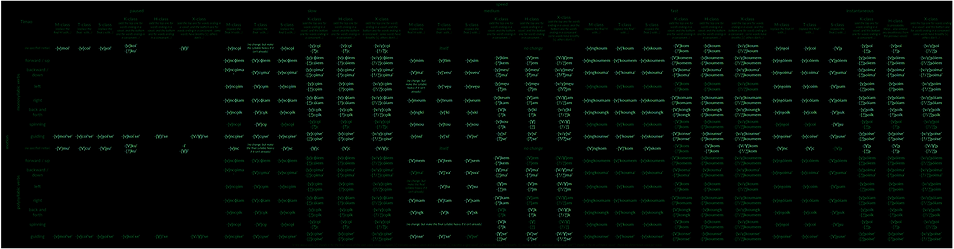
Wow this one is even harder to read. Here's a higher-quality version to check out. Boxes that are darkened are repeats of simpler forms ; for example, the M-class ending for monosyllabic verbs that indicates "moving fast to the left" is -[v]ngkoum, the same ending as simply "moving fast", so that box is darkened.
Timao has the same H+X class unpredictability as Eza, with added unpredictability in its K-class verbs, and slightly different patterns for monosyllabic and polysyllabic words. These are all for the same reason as Eza, but it behaves slightly differently. This is because while Eza lost final breathy vowels regardless of their stress, Timao lost all final vowels, but only when they're not stressed.
As these go before perfective marking and infinitives, it's important to note that when these suffixes are added, the final one indicates what class the verb will take when adding additional suffixes past it.
Paused is T, Slow is X, Fast is M, and Instantaneous is X.
Forward/Up is M, Backward/Down is T, Left is H, Right is M, Back and forth is K, Spinning is also K, and Guiding is T.

Here's a higher-quality version to check out. Boxes that are darkened are repeats of simpler forms ; for example, the M-class ending for monosyllabic verbs that indicates "moving fast to the left" is -nkon or -fkon, the same endings as simply "moving fast", so that box is darkened.
As is expected with Kezgeza, despite this table being full of endings, it is still not exhaustive. Learners need to remember some other properties that Kezgeza features, such as some clusters turning to geminates, M/N turning to F next to breathy vowels (even when they'd been dropped), as well as which X-class verbs follow which pattern.
As these go before perfective marking and infinitives, it's important to note that when these suffixes are added, the final one indicates what class the verb will take when adding additional suffixes past it.
Paused is T, Slow is X, Fast is M, and Instantaneous is X.
Forward/Up is M, Backward/Down is T, Left is H, Right is M, Back and forth is K, Spinning is also K, and Guiding is T.
These suffixes are represented in their signed components simply by performing the sign in the designated motion or speed. As mentioned earlier, it's common to see the spoken suffixes themselves get entirely dropped in favor of the physical movement.
LdduRddHk LdduRddHk LddRddH0 TrduLduH2 LdduRddHk LdduRddHk OlTlhddoHo
N E G A T I V E S A N D P E R F E C T I V E S
Negatives and perfectives are not normally grouped together, but for Móga's case, most languages in the family use similar strategies to mark both, only with minor differences which tell them apart.
Besides infinitives (which acts as its own thing) and the wide array of motion suffixes*, these are the only two other markings verbs may have ; verbs may be positive (unmarked) or negative (marked), imperfective (unmarked) or perfective (marked), or a combination of the two.
* one can argue the perfective is also a motion suffix, since it marks the finishing of an action...
Starting with negation, Wëzo̤le̤'s strategy is the exception, as it's analytic and very simple. Just add LduRddH0 Kai before the verb!
.RduOTrdduLhduiHk
Mo̤me se̤.
I am reading.
.RduOTrdduLhduiHkLduRddH0
Kai mo̤me se̤.
I am not reading.
And for perfective verbs, simply follow this table to inflect properly. Overall, Wëzo̤le̤ is definitely the simplest of the documented Móga languages in terms of negative and perfective inflections!

So for example, the L-Class OLduuRdudui Mázei ("crying") would turn to OLduuRdudui Mázeli̤s ("cried"), and the M-Class OrTrduRduH2 Ëmoot ("coming along") would turn to OrTrduRduH2 Ëmlomi̤s ("came along").

Eza's negation strategy is much more traditional, using a suffix to indicate negative verbs. This suffix is -pi, which will usually nasalize and front the vowel that comes before it. And depending on the class of the verb it's modifying, the vowel may also become long, and/or the consonant preceding it may become aspirated. See the chart below for a full breakdown of how different verb conjugations interact with the suffix ;;
So, following this table, the K-Class verb OruiTlduu Riske ("swinging") would negate to OruiTlduu Riskhĩpi ("not swinging"), and the R-Class Tur ("pressing down upon") would negate to Tüpri ("not pressing down upon").
In some infrequent cases, an unexpected vowel may appear between the verb and this suffix, such as in the X-Class example Has ("rising") vs. Hathẽpi ("not rising") ; In the chart above, this unknown vowel is indicated as [V]. While there's no surefire way to know when this might happen (nor which vowel will appear) within Eza itself without memorizing, check its relatives! If the word has a cognate in Wëzo̤le̤ that ends in a breathy vowel, Eza's negative form of the verb will have a fronted version of that extra vowel.
Another exception to keep in mind is that H-Class verbs with no final consonant, like Kha ("thinning out") lose their breathiness upon being inflected. In this instance, it'd turn to Kẽpi ("not thinning out").
Though this is how it's spelled, it's very common for Eza speakers to shorten this -pi to just -f when speaking! For the examples used here, they'd turn to Riskhĩf, Tüf, Hathẽf, and Kẽf.
Rha wator kho riske, ru khe riskhĩf.
I'm swinging on the branch, and you're not.
The table for perfectives has a very similar pattern ;;

So for our previous examples, we'd get Riske -> Riskhir, Tur -> Tüür, Has -> Hather, and Kha -> Ker.
To make a negative perfective, conjugate a perfective, then add the negative suffix agglutinatively, treating the perfective suffix as an H-Class verb. So we get Tur -> Tüür -> Tüürĩf ("not finished pressing down upon"), or Has -> Hather -> Hatherĩf ("not finished rising")
Eza can also put an auxiliary word Puh after a verb for a Habitual aspect. Combining this with a perfective gives a meaning of "used to".
Timao uses what seems like Wëzo̤le̤'s and Eza's negation strategies into one, using an initial word OLduRddHw Ko' before the verb, and a suffix -m/-mei/-vei/-u after it, depending on its declension and number of syllables. Though Ko' is spelled with a final glottal stop, it is rarely pronounced fully in fluid speech ; in fact, if the following verb starts with H, it's common to also drop both the glottal stop and the vowel in Ko' as well.

Though about equal in complexity to Eza's, Timao's endings seem a lot more complicated because we need to consider the weight of vowels in relation to each other. Let's show some examples ;;
OluiTrduddoLduRddHk
OTrddLduH1
OluiTrddLddRduHo
OLduduiRdudui
OluiTrddLduRdd
So
Speaking (X-Class)
Ham
Jumping (M-Class)
Veuk
Serving (K-Class)
Mousa'
Shedding a tear (T-Class)
Koum
Jogging to the left (H-Class)
OluiTrduddoLduRddHkOLduRddHw
Ko' somei
Not speaking
OTrddLduH1OLduRddHw
Ko' heum
Not jumping
OluiTrddLddRduHoOLduRddHw
Ko' veuki̤m
Not serving
OLduduiRduduiOLduRddHw
Ko' mousatu
Not shedding a tear
OluiTrddLduRddOLduRddHw
Ko' koumam
Not jogging to the left
As with Eza, some words gain an extra vowel when they negate, seen in our examples OluiTrddLddRduHo Veuk -> OluiTrddLddRduHoOLduRddHw Ko' veuki̤m and OluiTrddLduRdd Koum -> OluiTrddLduRddOLduRddHw Ko' koumam. The quality of this vowel is different for each word and can't be figured out from context alone, so it must be memorized ; checking the vowels in Wëzo̤le̤ cognates certainly helps, though!
And at an initial look through the table, it would seem that OLduduiRduduiOLduRddHw Ko' mousatu should be Ko' mouseutu, but this is not the case ; The weight of the initial syllable is already heavy, so the stress is already being put on that syllable and not the more standard one listed on the table.
And also like Eza, Timao's perfective chart is quite similar to its negation chart. Just remember that perfectives don't need Ko' in front of them!

So for our previous examples, we'd get So -> Soʂe̤i, Ham -> Hanʂe̤i, Veuk -> Veuki̤ʂ, Mousa' -> Mousac, and Koum -> Koumaʂ.
To make a negative perfective, conjugate a perfective, then add the negative suffix agglutinatively, treating the perfective suffix as an H-Class verb. So we get Ham -> Hanʂe̤i -> Ko' hanʂe̤im ("not finished jumping"), or Koum -> Koumaʂ -> Ko' koumaʂim ("not finished jogging to the left")
Directly borrowed from Eza, Timao can also put an auxiliary word Mṳ after a verb for a Habitual aspect. Combining this with a perfective gives a meaning of "used to".
Kezgeza follows Eza's strategy of just a suffix, and the patterns are pretty similar to what we've seen from Timao, but watch out for some unexpected changes between negative and non-negatives ;;
OLddddiRddddiH0
neaOLhRhHo
L
OLhduoRhduoH)
kok>etO
Tfat
Ending (T-Class)
Áen
Asking for (N-Class)
U
Sleeping (K-Class)
Fto̤tt
Defining (T-Class)
Tëkok
Splashing (X-Class)
ftaftOLddddiRddddiH0
Tfatf
Not ending
meaOLhRhHo
f<uHL
ftittfOLhduoRhduoH)
faHkok>etO
Áem
Not asking for
Ṳ̈f
Not sleeping
Fttitf
Not defining
Tëkoká̤f
Not splashing
As evident in the last two examples Tëkok -> Tëkoká̤f and Fto̤tt -> Fttitf, Kezgeza's tendency to cluster consonants causes some inflected words to lose vowels and/or gain unexpected ones in other places. There's unfortunately not a great way to intuit these on their own, but if there's a breathy consonant or i in the root word, that's one way to guess there's some surprise vowels that might show up in its inflected form.
Perfectives are, predictably, equally as unpredictable, but in a sense, when comparing them to the negatives, you might be able to spot some patterns!
imt<aftOLddddiRddddiH0
Tfac
Ended
meaOLhRhHo
f<uHL
SaHkok>etO
StittfOLhduoRhduoH)
Áenc
Asked for
Şi̤
Slept
Tëkoká̤ʂ
Splashed
Fttic
Defined
(yeah this is just way too hard to analyze with a neat lil table... ;v; if you end up analyzing it yourself and come up with a strategy, lmk!)
To make a negative perfective, conjugate a perfective, then add the negative suffix agglutinatively, treating the perfective suffix as an H-Class verb. So we get Áen -> Áenc -> Áencf ("not finished asking for"), or U -> Şi̤ -> Şi̤f ("not finished sleeping")
LdduRddHk LdduRddHk LddRh
I N F I N I T I V E S
Móga languages make use of a particular marking on verbs to fulfill a number of purposes, which we're denoting as their "infinitive". This, however, does not match up entirely with english's infinitive and the way it works ; In the sentence "They like to help", the infinitive verb in english is typically analyzed as "to help". Móga languages instead treat the infinitive as the "like to" portion of this sentence. As such, the first verb in this auxiliary construction is considered the infinitive, and given a spoken agglutinative suffix.
Kken
Like
i
Help
U kkëfo̤ i.
They like to help.
This is a pretty pervasive feature throughout the family, though many have gone through sound changes that have caused the infinitive suffix to only show up on certain verbs, and/or only change the verb's stress instead of having a suffix at all.
It should be noted that infinitives are always applied last when speaking a verb. If it also has speed, motion, perfective, and/or negative suffixes, they are applied in that order, and then the infinitive is applied at the end. And like these other suffixes, these are only present in the spoken component.
The most transparent implementation of this is Wëzo̤le̤'s system, which will always suffix a breathy -a̤ to indicate an infinitive. Just remember that if a verb's ending has been metathesized (like in OlTlduLhH3 Kizoot, for example), put the ending consonant before the final vowel (so Kizloo in this instance), and then apply the endings on this table!

While Wëzo̤le̤'s are the most transparent, Eza's are the most simple. About a third of verbs do not change at all for their infinitive, with another third applying a simple additional consonant, and the final third lengthening the vowel.
Keep in mind that if an H or X class verb ends in a consonant, there is no final vowel to elongate. When this happens, it will add another long vowel to the end instead of lengthening the one before the consonant. The actual quality of this vowel is unable to be determined by phonetics alone, and is determined word-per-word.

This certainly looks like a lot more, but in reality it is still pretty simple with only a few complications. 2/3rds of all monosyllabic verbs have an -o̤u ending, nearly all disyllabic verbs don't change at all, and any larger syllable counts shift the stress to the end.
Keep an eye out for some rare exceptions in Timao's infinitives, such as So ("dance") which is infinitivized to Soi instead of the expected Sou.

As usual, Kezgeza's patterns are the most difficult to pin down, and there are a fair amount of edge cases and exceptions to the rules listed below. It is pretty clearly similar to Timao's infinitive marking table, though!

Now that we have an idea on how infinitives are formed, let's see how they're used!
Using the simple infinitive construction of verb1=INF verb2, Móga languages convey a number of grammatical moods ;;
-
Putting Oma̤ / Hũf / Humo̤u / Ufo̤ ("hold", infinitive) before the main verb gives the sentence an Abilitive mood.
- For a Permissive mood, Óméa̤ / Hũũpaa / Hoimeu / Úmɐ ("hold to the left", infinitive) is used.
- For a Commissive mood, Omema̤ / Hũpãf / Humeum / Umaf ("hold to the right", infinitive) is used.
-
Putting Sáa̤ / Roo / Soi / Şo ("dance", infinitive) before the main verb gives the sentence an Invitational mood.
-
This is usually phrased as a question, which feels more polite. In Eza, it is always a question.
-
Eza has a shortened form of this phrase, Ho roo? ; this acts sorta like a generic "Shall we?"
-
-
Putting Soga̤ / Ruh / Şo̤u / Şuko̤ ("and", infinitive) before the main verb gives the sentence a Conditional mood.
-
This is strange! "And" is certainly not a verb in Móga languages, but it seems to have attached an infinitive suffix regardless, and is working as a verb only in this context.
-
In Eza, it is only an Implicative conditional. See the questions section for a Predictive conditional.
-
Timao's infinitive here is Şo̤u, an exception to the more expected Şuko̤u.
-
-
While not a mood specifically, the general copula can be put in the infinitive as Ëma̤ / Hẽf / Hemo̤u / Ëfo̤ to effectively "passivize" the subject, indicating they have less agency than normal.
And there are some preset constructions using infinitive verbs in front of nouns or adjectives ;;
-
The verb Sëgé̤a̤ / Rekhaa / Seke̤u / Şeka̤ ("use", infinitive) is put before a noun to give it an Instrumental meaning.
-
Some adjectival modifiers, such as the comparative, use infinitive verbs in their constructions. These few can be found in the Adjectives section!
These aren't the only situations where infinitives are used, though. Their other main use is for Relative clauses and Verb nominalization, which puts a verb (or a verb phrase) in the infinitive before the noun it modifies, acting almost like a big adjective. This sort of construction works very similarly to how it's done in Japanese! Whereas Japanese simply puts the verb in its normal, base form for this, Móga languages choose to use the infinitive.
Kóves se̤u ma̤ʂe̤i humois.
It is the box that I saw.
(literally, "[it] the I-saw box [is]")
Keep in mind that though they connect to adjectives, case prefixes do not connect to relative clauses and infinitive verbs. In a sense, their lack of connection indicates that they're marking a nested clause!
TlduddoLduddoRddduoH0
R E F L E X I V E S
All Móga languages have a single reflexive word, Wëgei / Wekar / Vekeus / Ëkaʂ, which can mean "myself", "yourself", or any other reflexive words.
Ş mɐtokɐʂ ɐtoʂ ʂóko umuʂ ma...
I see myself in the black box...
(here, Ëkaʂ is in the absolutive case as Mɐtokɐʂ.)
This reflexive word is generally quite useful, in particular for complex sentences which in english might use relative clauses. For example, one of our researchers heard this sentence ;;
.TrduLhdRhddoH3oHzikTrduOlTldduTlhLddHoTlhLhuRhduoH1TrduaHizm>emeOTrhddoLduH1H1TrhduoH1LhduoRddhoH3TlduddoLduddoRddduoH0kiimotRhRddddiHo
Wei tomiik wëgei mo welai ei emëmzía̤ kë̤ të izmago̤ sii kizo̤ eleok.
Their temple is in the clearing you originally came from.
LOC COM=GEN REFL life LOC=VOC one jump=FORWARD=PFV=INF 2SG DEF clearing hang GEN=3SG temple
In the above sentence, the reflexive TlduddoLduddoRddduoH0 Wëgei is standing in for TlhLddHoTlhLhuRhduoH1 Të izmago̤ ("the clearing") which is stated later on in the sentence. This is because the construction is literally translated as something like "In the, from-the-clearing-originally-came-you clearing, lies their temple." As "the clearing" is referenced twice, it is reduced to a reflexive in the relative clause.
Reflexives may also be used in intransitive sentences where the noun is considered to have agency, such as Khe kõ ("You run") ; this subject is marked in the ergative, and as such, there is no absolutive case in the sentence. In this instance, there's simply no way to convey evidentiality! This is allowed, but if it's absolutely essential that they convey a certain evidentiality, speakers might include the reflexive for a statement like Khe kookar kõ ("I see that you run yourself"). And since Móga languages allow ergative subjects to be dropped when context is clear, a sentence like Kookar kõ allows a reflexive to exist without its referent and still be grammatical!
C O P U L A E A N D Q U O T E S
OlTlddu , TlhLhRduHc , TrdduHk , O
Móga languages generally have different copulae for different situations. The first copula we'll look at is O Ëo / O Hẽ / O En, easily the one with the broadest meaning and the most use-cases. This word originally meant the verb "Face", as in to orient the body toward something, like in the example sentence Rha koh hẽ ("I am facing you"). In all documented Móga languages, the verb retains this meaning.
However, it has also generalized to a more copular meaning. In both Wëzo̤le̤ and Eza, the above example sentence also conveys the meaning of "I am you"! In that instance, it's pretty obvious what meaning is intended, even from what little context we have ; Most of the time, there's little ambiguity!
Though Kezgeza does use O En as a copular type of verb, the specific construction "X faces Y" is not ambiguous with the copula construction "X is Y". This will be evident in the example provided below ; More information on this construction in particular can be found further down when we talk about quotes!
In simple copular sentences like this, Timao has dropped this verb entirely.
Kagë̤ ëo se̤.
I am facing you. / I am you.
Rha koh hẽ.
I am facing you. / I am you.
Se̤u koki̤ hem.
I am facing you.
Se̤u koki̤.
I am you.
Ş kök en.
I am facing you.
Ş kokaʂ k en.
I am you.
This verb is also the primary verb used in quotative sentences, one of which is presented in the example below. It is constructed by stating the speaker (Rha, "I"), then an absolutive marker combined with the quotative word (Tikar in this instance, implying it is primarily heard and not seen), then the quote itself (Rarhaaĩr, "thank you"), then the copular verb. As with the other use of this copula, Timao drops it in quotative sentences as well.
Rha tikar rarhaaĩr hẽ.
I say "Thank you".
In isolation, Eza appears to have several similar features to Hindustani. The copula Hẽ also sounding similar is also a complete coincidence!
Kezgeza uses this quotative as its simple copular sentence! In fact, its endonym OTlddLddRhH# Kaʂkaʂo is in direct reference to this, as it was likely originally this quotative copula that first separated it from its Móga siblings. As such, the grammar in the above example could technically also be interpreted as "I am thank you" in Kezgeza, but this isn't very sensical, so the intended meaning is quite clear.
The next copula to discuss is TrdduHk Mei / LuiTrduduiHk Pas / TrduduiHk Ma' / OrTrhduiHo Mat, and is effectively the negative version of the normal copula. In any situation where the positive general copula can be used, this one can replace it for a negative meaning! As such, it is also used for negating quotes too. Some speakers, especially children, might just negate the simple copula more normally (making Kai ëo, Hẽẽf, Ko' heum, and Em, respectively), but using the specific negative copula verb is much more widely accepted.
Be careful with this word! In sound alone, it is identical to TrddLhRh Mei / LuiTrddLhRh Pas / OluiTrddLhRh Ma' / LddRdd Mat, meaning "yes" ; the signed component is essential to understanding if this is a positive or a negative. In Timao, OluiTrddLhRh Ma' also doubles as the standard absolutive general knowledge preposition, and therefore the two can often coexist in a sentence!
Melolei ëo.
They are a friend.
Melolei mei.
They are not a friend.
Hapratutar hẽ.
They are a friend.
Hapratutar pas.
They are not a friend.
Ma' huteus.
They are a friend.
Ma' huteus ma'.
They are not a friend.
Kkaʂ aútáʂ en.
They are a friend.
Kkaʂ aútáʂ mat.
They are not a friend.
For adjectival copular sentences, such as "They are strong", some Móga languages use a different form of the standard copula which takes the same signed component but is orally spoken differently. In Wëzo̤le̤, this verb is O Tomëo, and in Eza, it is O Tũpẽ. As it's a form of the simple copula, Timao does not use this, while Kezgeza prefers to stick to O En regardless of the object being an adjective or not. This verb is still negated by the negative copula strategy above, though it isn't uncommon for some speakers to prefer a more standard negated form like Kai tomëo and Tũpĩf.
Kama tomëo.
They are strong.
Kora tũpẽ.
They are strong.
Ko kekeu'.
They are strong.
Kokaʂ kekat en.
They are strong.
All documented Móga languages also make use of a locative copula, which is a completely separate verb than all the other copulae we've discussed so far. This one is relatively simple ; just use the verb OlTlddu Sii / OruiTlduu Ris / OruiTldu Şi' / OTlhu Şit to indicate being at a particular place. This verb also doubles as a meaning of "hang", likely originating from the idea of hanging in a tree! We even have a similar meaning in English in the form of the verb "hang out". Make sure to put the place in the locative case!
Weleleok sii.
They are at a temple.
Hasatuspo ris.
They are at a temple.
Va' mokeum ʂi'.
They are at a temple.
Aɐ́cókɐn ʂit.
They are at a temple.
This verb is often paired with the evidential markers in sentences that, in English, would not normally use a locative copula. For example, the sentence "I see them" would already be conveying the speaker's visual experience using the evidential marker on the object, and thus, the locative copula may be used instead of the redundant verb "see". Doing this would make the meaning closer to something like "I see that they're there"!
Q U E S T I O N S
OrRhduoHo OrRhduoHo
To make simple yes/no questions, Móga languages put the word LddRh A̤ / RuiTlddLddRh Ho / OLddRh Ho̤u / LddRdd O̤ at the beginning of the sentence.
Ke ʂit.
I see them.
O̤ ke ʂit?
Do you see them?
For more open ended questions, there are a couple question words that take the place of the object, time (locative), or the verb ;;
What (obj.)
Who (obj.)
Why / Where (loc.)
When (loc.)
Doing what (v.)
Tëi
Wi̤
Tëi
Tële
Sai
Tes
Whi
Tes
Teta
Ros
Te'
Ve̤i
Te'
Teteu
So'
Tet
Ü
Tet
Teta
Şot
Because these open ended question words already indicate a question, there's no need to put an extra indicator at the beginning of the sentence. It isn't ungrammatical to include it, though, as it can provide redundancy and clarification if desired. It should be noted that in Eza, the locative prefix attaches to Teta ("when") as Waateta, but this is nearly always shortened to Waat.
While question words are important in any language, they are especially important in Eza, which uses them extensively. This is most famously present in their very frequent backchannelling, which is done far more than other Móga languages. Eza has a number of words that serve purely to backchannel, with most having a direct correspondent to question words ; Which one is used is dependent on which aspect of the speaker's sentence the listener chooses to emphasize.
Tres!
What!
Kooh!
Where!
Waat!
Why! / When! / Which!
Wẽf!
Who!
Wek! / Kro!
How!
Rot!
Doing what!
No emphases are particularly more common than the other, but since Waat covers three different things, that word might be the most common one. Speakers of Wëzo̤le̤ certainly think so, since Eza is frequently known in slang as Wat wat.
Questions are also important for Eza's conditional moods. While most Móga languages only have one conditional, Eza makes the distinction between an Implicative conditional and a Predictive conditional. The implicative conveys that the action is somewhat systematically bound to happen (i.e. "if it rains, the lake will fill up"), while the predictive is predicting a result that may not be guaranteed (i.e. "if you trip, you will get hurt").
Eza's implicative is expressed the same way the other conditionals are in Móga ; putting "and" in the infinitive and placing it in front of the verb. The predictive, however, uses question words ; it effectively involves the speaker asking a question, and then answering it. For the example earlier, it could either be phrased like "When do you get hurt when you trip" OR "Doing what hurts you tripping". Both mean effectively the same thing, just with subtle difference in emphasis and context.
Pask waat thores weskir hürirẽf hi.
If you trip, you will get hurt.
ABS.GKN=2SG LOC=when hurt=GUIDING LOC=GEN fall=FORWARD=INF time
Pas ros khe thores hürirẽf.
If you trip, you will get hurt.
ABS.GKN doing_what=INF 2SG hurt=GUIDING fall=FORWARD=INF
In a sense, this conditional construction fits with the way Móga languages allow the subject to be shifted to the end of the sentence in order to emphasize the object. It was likely a contributing factor in how this was able to develop!
LdduRddHk LdduRddHk OLddHk
A D J E C T I V E S
Adjectives go before the nouns they modify, and attach to case markers where relevant. They are relatively simple, and other than attaching to the cases, they do not inflect for anything. We'll use the adjective Së̤ / Rhe / Si̤ / Şe̤ ("hot, warm") for our examples in this section, as it stays relatively consistent between the four languages.
Firstly and most simply, adverbs are made by putting the adjective in the locative case, and placing it before the verb where all the other locative and comitative constituents go.
And to make many comparatives, superlatives, etc., adjectives take particular phrases that associate them with deities of the Wëza̤m pantheon. These vary a little depending on the language, but are, for the most part, relatively consistent. The most consistent one is the excessive adjective construction, "too X" ;;
Huskeis ka'vous si̤.
It is too hot.
This translates directly to "Ka'vous's hot". Ka'vous (as is pronounced in Timao) is the god of fire, known for their excitable, wild, and unpredictable personality. As such, they became associated with excess. All documented Móga languages have this exact construction for excessives. In a sense, it's a bit ironic that Ka'vous's in particular is the most consistent across them!
Note that in the above phrase, the absolutive case with the tactile evidential (Hus-, in this instance) is used. This is purely because "hot" is something the speaker would feel. If it was a different adjective, that might be different ; "bright", for example, would likely use the visual evidential!
Here are a few more constructions that use the deities. Keep in mind that even though Wëzo̤le̤'s god names normally begin with the vocative Wëz-, this prefix does not appear in the adjectival constructions ;;
This translates directly to "Tamë's hot". TrduLduddoRduddoH1 Wëzlamë (as is pronounced in Wëzo̤le̤) is the god of the sky, known for their eloquence, strength, and intention. As such, they became associated with the intensifier "very"! This specific construction is not present in Timao, but the other three have it.
Oziik tamë së̤ tomëo.
It is very hot.
Oziik tamë ei së̤ tomëo.
It is the hottest.
This translates directly to "Tamë's one hot". This is the same as the above, but with an extra word, which makes it into a superlative. In Timao, this is not the superlative, instead being the simple intensifier "very". This construction is not present in Kezgeza.
This translates directly to "Heh's hot". Heh (as is pronounced in Eza) is the god of fog, known for being ephemeral and forgetful. As such, they became associated with the the idea that a quality is just faintly there. In Timao, this means something more like "Not hot enough" rather than "a little hot".
Hükrir heh rhe tũpẽ.
It is a little hot.
Some adjectival modifications instead come from infinitive verbs, such as Ta̤meu' si̤ / Tfat ʂe̤, literally "closing hot" or "ending hot", which replaces the superlative in Timao and Kezgeza. Another is Elé̤a̤ së̤ / Hathaa rhe / Hate̤u si̤ / At ʂe̤, literally "growing hot", which is present in all documented Móga languages to mean a comparative like "more hot".
TlddLduRhH3 TlddLduRhH3
N U M B E R S
Móga languages use a simple base 6 system, counting using their head (1), right arm (2), left arm (3), right leg (4), left leg (5), and tail (6).
H1
Ei
One
H1
Wir
One
H1
Has
One
H1
Aʂ
One
RduH2
Wai
Two
LuiTrduRduH2
Wos
Two
RduH2
Vo'
Two
LhRhH#
Ot
Two
LduH3
RuiTlduLduH4
Këo
Three
Kẽ
Three
LduH3
LhRhH3
Kem
Three
Ken
Three
RduHc
LuiTrduRduH4
Mi̤
Four
Phi
Four
RduH4
LhRh
Me̤i
Four
Fi̤
Four
Ldu
RuiTlduLdu
Te
Five
Ta
Five
Ldu
LhRh
Ta
Five
Ta
Five
OTlduLduRduH1
OruiTlduLduRduH1
Ma
Six
Po
Six
OruiTlduLduRduH1
OTlhLhRhH1
Mo
Six
Mo
Six
There are also special words for the numbers 7-12. Note that they use the same signs as the number 6 places before them ;;
H1
H1
Máei
Seven
Pooar
Seven
H1
H1
Móvas
Seven
Móɐʂ
Seven
RduH2
Maái
Eight
LuiTrduRduH2
Poos
Eight
RduH2
Móvo'
Eight
LhRhH#
Móot / Mot
Eight
LduH3
RuiTlduLduH4
Magëo
Nine
Pokẽ
Nine
LduH3
LhRhH3
Mokim
Nine
Möken
Nine
RduHc
LuiTrduRduH4
Mami̤
Ten
Pö̃f
Ten
RduH4
LhRh
Mome̤i
Ten
Möfi̤
Ten
Ldu
RuiTlduLdu
Male
Eleven
Pota
Eleven
Ldu
LhRh
Moteu
Eleven
Mota
Eleven
OTlduLduRduH2
OruiTlduLduRduH2
Walam
Twelve
Wospo
Twelve
OruiTlduLduRduH2
OTlhLhRhH#
Vo'vou
Twelve
Otmo
Twelve
From 13-36, the numbers follow a simple pattern ; note, however, the numbers 1-5 are put in the comitative.

Note that Timao does not detach its comitative prefix in numbers! 19 is Kim cumeus, not Kim coi has.
This pattern continues past this ; in Wëzo̤le̤, for example, 38 is RduH2OTlduLduRduH0 Mama toma̤i, 47 is LduOTlduLduRduH0 Mama tómale, and 51 is
LduH3OTlduLduRduH2OTlduLduRduH0 Mama toma̤lam tomëok. 72 is OTlduLduRduH0OTlduLduRduH0 Mama tómama, and the pattern can keep stacking from there. As a result, traditional number names can include long sequences of similar syllables! For example ;;
Põpo tũpõpo tũpõpo tũpõpo tũpõpo tũpĩpo tũphos.
Two hundred and six (traditionally)
This can, of course, get a bit unwieldy. As such, Timao has developed a strategy for simplifying larger numbers ;;
Just as Mo (6) turns to Vo'vou (12), Kim (18), Mimou (24), and Ta̤mou (30), Timao speakers have innovated Momou (36) to turn to Vo'voum (72), Kimoum (108), Mimoum (144), and Ta̤moum (180), as well as recursively onto itself as Momoum (216), Vo'vomoum (432), Kimomoum (648), etc. ; This drastically reduces the number of repeated syllables needed ;;
Ta̤moum coimim cumo̤u'
Two hundred and six
The other Móga languages have been quickly adopting this strategy as well, given its usefulness ; but due to it being established in Timao, these specific number words are getting borrowed in as loans and as such don't fully match the phonemic pattern of numbers in their own languages. Some older Tézilei still prefer the older system, which they feel is just more consistent, though it's clear it is going out of fashion.
LdduRddHo
W R I T I N G

All documented Móga languages share a writing system, which they call LdduRddHo Ë́zmo / RuiTldduLdduRddHc Hööspü / OLduRddHo Heusmu / LhuRhuHo Ë́ʂmü. It was innovated and standardized by the Kezgeza-speaking band, when the sound changes of Kezgeza's cluster-heavy phonotactics made spelling with the traditional syllabic pose characters of Ancient Móga rather unintuitive. Some characters (W/V, the nasal vowels, and H) were added later to accommodate for Eza's phonological inventory once it was adopted by the other main bands.
It has two components: a more complex system which represents signed components, and an alphabet that represents the spoken word. As it is much simpler, we'll start with the alphabet, which is pictured to the left.
This alphabet is written right to left, and in total has 36 letters ; Many, though, are simple variations of other characters, and the maximum number of letters used in one language is Kezgeza, with 23. In fact, there are four letters on this table (Ö̤, Ṳ̈, Ä̤, and Ɐ̤) that are mostly just theoretical and incredibly rare to find!
For the most part, there are no spelling quirks, though some allophones are not distinguished. Here's some notes on the spelling ;;
-
Despite being phonemic in most Móga languages, spelling does not mark stress.
-
Wëzo̤le̤'s voiced allophones are not distinguished in writing. As such, T and L share a character, as do K and G, and S and Z.
-
Diphthongs and long vowels are written by simply putting two vowels next to each other. If the diphthong is breathy, both vowels are to be written breathy!
-
The letter M is pronounced as P in Eza, and the letter Ş is pronounced as R.
-
Eza's negative suffix -pi is often reduced to -f in speech, but is usually still written as -pi.
-
Long vowels are written by simply duplicating the vowel.
-
Eza writes breathy syllables by putting H after the consonant ; as such, they do not use any breathy vowel characters.
-
The letter W is pronounced as V in Timao, and C is written as a digraph TŞ.
-
Timao's nasal allophones N and NG share a letter, but M is separate.
-
Diphthongs are written by simply putting two vowels next to each other. If the diphthong is breathy, both vowels are to be written breathy!
-
Geminates are written by simply duplicating the consonant.
-
C is written as a digraph TŞ.
The order they're displayed in this table, from right to left, top to bottom, is the traditional order the letters are listed in. Though word lists are usually "alphabetized" using their signed components, when words have identical signed components, the alphabetical order is then taken into account.
They also have four main punctuation marks, which are put after a clause. . functions as a period, , as a comma, and ,, works like an ellipses. There are two less common ones, like ! which can optionally fit the role of an exclamation point, and -, which doesn't neatly fit into any category and varies per person, but are often used like optional quotation marks. There are no spaces between words, but the sign characters are very effective at separating word boundaries, so this is almost never an issue. Onto those sign characters...
All sign characters are made using a combination of the glyphs to the right. The arms and tail take the lines defined on top chart, arranged how they would be on the person signing ; legs go under them, and hand shapes are put above the limbs. Though the top chart just says it's for the left arm, that's all we need to show everything, since it can also be duplicated for the tail, and flipped for the right!
For example ;;
OTlddLddRhH#
Kaʂkaʂo
Kezgeza

Above, we've written the endonym sign for Kezgeza in this system. It features open legs, tail diagonal down, left arm diagonal down, right arm horizontal, and a hand shape where the thumb, index, and middle finger are extended.
Notice that the center of the "body" is not the center of the written sign. This isn't too uncommon to see here! It's generally written this way purely for aesthetics, to fit all the lines in a smaller space. Since there's two limb lines stacked on one side and one on the other, it's not ambiguous at all.

Their written signs do certainly get ambiguous though. For example, is the simple sign Ldu intended to be left arm diagonal up, or right arm diagonal down? Which arm is horizontal in the simple sign Rh ? Unfortunately, there's no good way to tell on its own... There's also the issue that any additional movement in a sign besides its initial pose is completely unwritten. But this is where the alphabet comes in!
Often in daily Móga speech, signs alone aren't the only thing they use to convey information, since they also have a spoken component to the language ; So when writing signs down and meaning might be ambiguous, the Ë́ʂmü system writes out the spoken pronunciation of the sign after it. With a combination of signs and phonetic spelling, word boundaries are clear. What is considered "too ambiguous" and "definitely unambiguous" is a case-by-case basis and entirely up to the writer, though! On signs and ornamental text, the alphabet portion is often dropped entirely.
Because this font partially emulates signed components, which don't have a great way to transcribe into a latin keyboard, using this font might feel quite unintuitive at first. If you're interested in using it, here's some things to get you started on how it works ;;
-
Written signs are typed out in a specific order, going up the body: this order is Leg shape, Tail side and angle, Left arm, Right arm, Hand shape. If one is not applicable and/or unwritten (for example, a sign which does not include the tail), that step is skipped.
-
Each step begins with a capital letter to ensure boundaries between steps are clear.
-
-
The "Both out" leg shape O is written as O (for "out"), the squatted shape OS is written S in words and OS on its own, leaned Z is Z (sorta like the shape the body makes) and leaned further L is L.
-
"Out left" Ol and "Out right" Or are written Ol and Or, respectively.
-
Bent legs are then notated by lui or rui depending on which leg is bent, so for example, Olui is Olui, and Srui is Srui. These stand for "out, left, up, in" and "squatted, right, up, in", respectively.
-
-
Tail steps always begin with Tl if the tail is on the left of the body, and Tr if it's on the right.
-
After that, simply follow the table! Use the first letters of the upper arm angle, then the first letters of the forearm angle. So Tail left, diagonal down, horizontal out Tlddho would be Tlddho. Tail right, diagonal up, diagonal up in Trdudui would be Trdudui.
-
Since the the second components of the (very common) combinations diagonal down + diagonal down out, horizontal + horizontal out, and diagonal up + diagonal up out are redundant, these combinations are reduced to dd, h, and du, respectively.
-
-
-
The left and right arms can take the same angles as the tail, so simply do the same for those, using L and R instead of Tl and Tr!
-
Hand shapes are indicated with a capital H, then a specific character. (in hindsight, it would have been more intuitive to just say Hcf for closed fist, Him for index+middle etc.... oops...)
-
Closed fist is H0 ; zero fingers.
-
Thumb up is Ht ; t for thumb.
-
Thumb and index is Hl ; your fingers make an L shape.
-
Thumb, index, middle is H# ; it's 3 + shift, since there's three fingers, and already an H3.
-
Open hand is unwritten.
-
Thumb and pinky is Hw ; your hand makes somewhat of a W shape. This has been merged with H# in writing, but is still distinguished on real hands.
-
Index finger is H1 ; it's how some people count, representing the number 1.
-
Index and middle is H2 ; it's how some people count, representing the number 2.
-
Index, middle, ring is H3 ; it's how some people count, representing the number 3.
-
All except thumb is H4 ; it's how some people count, representing the number 4.
-
C shape is Hc ; you can probably guess this reasoning
-
O shape is Ho ; this one too
-
Index, ring, pinky is H& ; (i'll be honest idr why i went with this LOL but it's actually not a shape that's used at all anymore in these languages so its oke)
-
Index, pinky is Hv ; your hand makes somewhat of a V shape.
-
Middle finger is Hm ; m for middle. And if it's not clear, Móga languages don't have any rude associations with this hand shape!
-
Middle, ring is H@ ; it's 2 + shift, since there's two fingers, and already an H2.
-
Ring, pinky is Hk ; it looks similar to our "Ok!" hand shape.
-
Pinky is Hp ; p for pinky.
-
O shape, pinky is H) ; it's sorta like H0 and it's 0 + shift. (yeah this one especially doesn't make much sense in hindsight...)
-
-
With all the above information, every sign (that has been documented, and thus actually given a ligature) can be typed! Our example from earlier, OTlddLddRhH#, is typed as OTlddLddRhH#.
-
The alphabet is written, for the most part, pretty 1:1 with their romanization. It is always typed with lowercase letters, except where there are a few necessary modifying ligatures ;;
-
Breathy versions of consonants can be made by typing a captial H after the vowel. So a is a, and aH is aH.
-
Nasal versions of consonants can be made by typing a captial N after the vowel. So i is i, and iN is iN.
-
If a vowel has a backed version, type > (representing "back") before it. So e is e, and >e is >e.
-
If a vowel has a fronted version, type < (representing "front") before it. So u is u, and <u is <u.
-
Since s already represents s, the capital S represents S. Typing lowercase r will also get S though, since they're represented by the same letter.
-
-
For punctuation, . is written with a period, , is a comma, and ,, is two commas. ! is an exclamation point, and - is a hyphen.
-
Given there are no spaces, if ever two characters combine when they're not supposed to, & is a zero-width character that can be used to separate ligatures if necessary!
Hey! Zewei here.
Included in this font is only the ligatures I've made for this project! There wasn't a great way to streamline the creation of them this time, unlike what I was able to do for the writing in 28L. Turns out making logographs for four languages takes a long time. >v<
If you've felt like this documentation had less of the writing system on it, that's why! Thank u as always for ur support <3
LdduRddHk LdduRddHk H1 H1 eH s o k TrhduiLhRhHk TlhLhuRhduoH1
A N C I E N T M Ó G A
Ancient Móga, or Mṳso as it would have been known, is the reconstructed ancestor of all Móga languages. Its name still survives in Wëzo̤le̤ today as TrhduoLhddoRhduoH3 Mo̤za, though the meaning has shifted and now refers to a ceremonial retelling of a story.
Not much is known about the speakers of this ancient language, other than their culture being a similar, older form of the Tézilei cultures we see today ; it's highly likely that the many Tézilei stories passed down through the generations originated from this ancient culture. As ancient Móga writing can be found all throughout the cycle, some of you might be interested to learn more about it!

This is a reconstructed inventory of sounds present in the ancient language. It's likely that both H and W were only present at the beginning of words. Note that even though we know there were 5 vowels, the exact placement in the mouth is not fully known, so what's presented here is simply an educated guess.
Their signed inventory seems to have been similar to all present Móga languages, notably with less leg combinations ; only closed, open, squatted, and both leans are present.
The full inventory of distinct hand shapes is unfortunately not known, but estimates presume there to have been about 20, larger than all known Móga hand inventories today. It's estimated that Timao's signed components have changed the least out of its siblings, including the hand shapes.

Just like today, ancient Móga was written right to left, with a sign character followed by a phonetic transcription, using no spaces. However, instead of an alphabetic system, they used a syllabary as pictured here. To make a syllable like Kam, they'd take the character KA and combine it with AM.
There are notably two breathy vowel sets, which seem to be a result of historical spelling.
Signed characters were simply taller versions of their respective poses in this same style, notably lacking any written hand shapes at all ; this is partly why there's no consensus on how many hand shapes there were, nor what exactly they looked like.
As text has been primarily found written in one-sentence lines upon stone walls, it is unknown whether this writing used any punctuation.
At the moment, this font isn't available for public download!
Overall, it seems Móga languages have been relatively conservative grammatically. The ancient language had all present cases (besides Wëzo̤le̤'s vocative), the definite prefix, the null case combinations, verbal motion suffixes, and plural marking which reduplicated the final syllable ; It's common to see this reduplicated syllable written as a smaller version of the signed character. Negation was made using a simple suffix to the verb, surviving in most Móga languages.
There's an auxiliary after the verb, Muka̤, which survives as a habitual meaning in Eza, and later reloaned into Timao. Its original meaning is unknown, as it could be a habitual, but it's also suspected to be a simple past tense. The modern perfective strategy was present alongside this, but was not used as frequently as it is today.
Pronoun dropping could have also been less common, but this analysis may be a result of survivorship bias given most recoverable text is formal signage on temple walls.